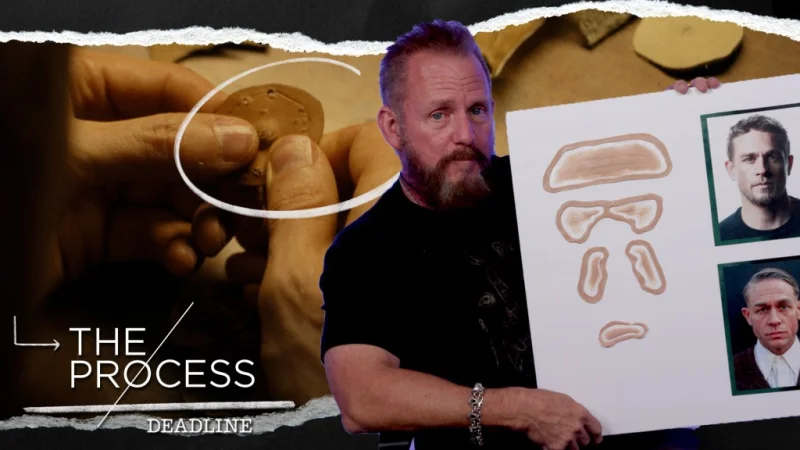
Charlie Hunnam said he built his Ed Gein performance for Netflix’s eight-part Monster: The Ed Gein Story by digging through the killer’s medical records and reshaping his voice around what he found. He also wore a hooded eye prosthetic that changed the look of his face enough to make the role feel like a different person onscreen.
Hunnam said he knew very little about Gein when he signed on, and that was part of the pull. Gein murdered at least two women and exhumed several bodies in the 1950s, later becoming the grim source for Psycho, The Texas Chainsaw Massacre and The Silence of the Lambs. The series now places Hunnam inside that history, with a performance built as much from paper records as from makeup.
What guided him most were the medical files. Hunnam said he worked through thousands and thousands of pages and focused on the transcribed biannual reviews from Gein’s nearly 30 years in a mental health facility. That material, he said, gave him a way to look past the headline version of the killer and toward the human being underneath it. He said he was interested in understanding what went wrong in the person who became the monster, not in repeating the most lurid parts of the story.

That approach also set up the central friction around the role. Hunnam said the books about Gein were grotesque and sensationalized the darker side of who he was and what he did, yet the job still required him to inhabit a real serial killer whose crimes have already been folded into pop culture mythology. Rather than lean on exaggeration, he used the records and the makeup as guardrails, trying to make the character feel specific instead of theatrical.
The prosthetic work was equally exacting. Corey Castellano and Mark Nieman mapped out the hooded eye design, the team took a life cast of Hunnam’s face, then sculpted and tested multiple versions before settling on a small silicone appliance. It was glued down with medical adhesive, its edges blended with acetone, and the final piece was painted in thin alcohol-based washes to match his skin tone. For older stages, the makeup team added a forehead, eyebags, crow’s feet, frown lines, nasolabial folds, and silver and gray in the brows to work with the wig.
That leaves the most interesting part of Hunnam’s performance only partly answered: how much of Gein’s voice and psychology came directly from the records, and how much had to be invented inside the shape of a man who left behind so little that was not already filtered through myth. The series is already out, but the lasting impression may be less the horror of Gein than the precision of the effort to keep him from becoming another cartoon villain.