


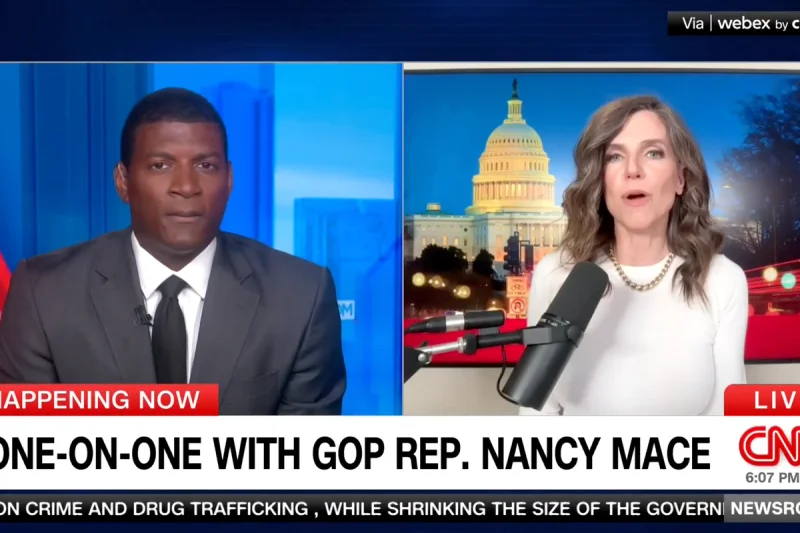
Nancy Mace was pressed on Sunday after posting that every single Muslim holding public office in America is a trojan horse and a threat to both national security and the republic. The South Carolina Republican Rep. doubled down in the interview, even as host Oscar Jimenez challenged her on whether she was targeting Muslims as a group.
The exchange came just as readers were looking for the latest fallout from Mace’s social media posts, which had already drawn sharp criticism and turned a Sunday interview into a live confrontation. Jimenez asked her directly, “Are you saying that anyone who is Muslim is a threat to this country?” Mace replied, “Uhh, and that’s not what I said,” then said Americans should be very concerned about Muslim politicians like Zohran Mamdani and Abdul El-Sayed.
Jimenez pushed back that there was no indication Mamdani had brought any of those ideas to New York City governance and that both men had been fairly elected by U.S. voters. Mace answered that Mamdani and Abdul El-Sayed entertained radical Islam ideology and shared communist ideology that was incompatible with American values. She also warned, “In the future, when our granddaughters are wearing burkas to school, we’re going to look back and say, how did this happen?”

That was the point Jimenez said crossed into fearmongering rather than political criticism. He said there was no evidence of granddaughters wearing burkas to school happening anywhere, and later added that the First Amendment protects freedom of religion. Mace responded that she did not want to hear the call to prayer five times a day in an American city and said worship should be limited to “the privacy of their own mosque or their own home, not on the streets of America.”
The friction was already there before the interview began. Mace had retweeted criticism of her post with the reply that not wanting to be blown up, stabbed, or rammed by a car by a radical Islamist in the United States of America made her an Islamophobe and that she would accept the label. Jimenez, who said he grew up in a Christian household in the South, told her Islam is not his religion but that he has Muslim friends and that how they worship is their right.
The broader interview also covered the Iran war, Jeffrey Epstein and the special primary in South Carolina to replace the late Lindsey Graham, but the fight over Muslim elected officials is the one likely to linger. Last week, Abdul El-Sayed won his Democratic primary, which made Mace’s comments land in the middle of a live political moment rather than as an abstract online skirmish. What remains unresolved is whether the posts and the on-air remarks will carry any political cost, or whether Mace’s line between criticism of Islam and criticism of Muslims will hold under the pressure of her own words.
