


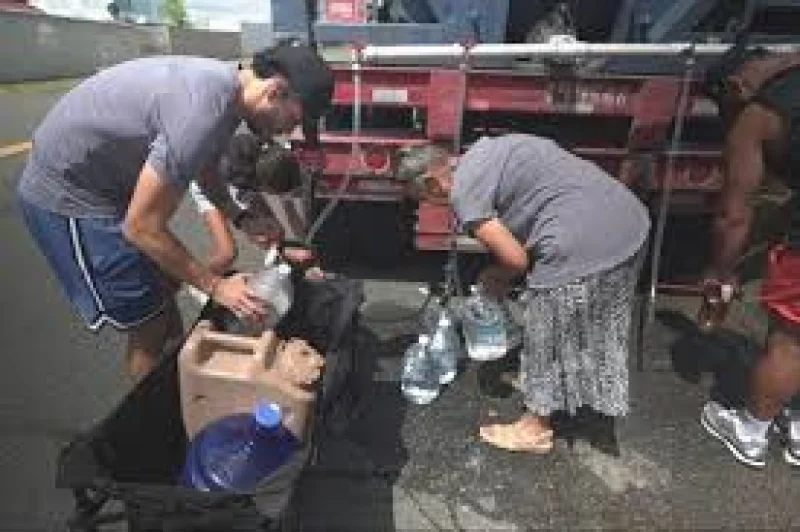
Hundreds of thousands of people in Puerto Rico's capital and nearby communities woke up on August 7, 2026 to no running water as a sweeping rationing plan took effect. More than 180,000 customer accounts in San Juan and six other municipalities were pulled into a schedule that splits customers into two groups and leaves each one without water for at least 48 hours at a time.
For Gloriany Baba, the cutoffs have turned daily life into a scramble. “It’s brutal,” she said. “It’s unbelievable to live through this today.” Her experience is now shared by households and businesses across a region where low-income Puerto Ricans are spending money on bottled water and the elderly are relying on neighbors and family to carry water to them.
The rationing is landing now because July was the driest month in more than 120 years in San Juan and the second hottest on record there, while about 36% of Puerto Rico is in severe drought and another 32% is in moderate drought. That is why the shutdown matters today: it is not a one-off outage, but the start of a wider emergency that is already reshaping life in communities in San Juan after at least 118 days of repeated water outages earlier in 2026.

Puerto Rico's water authority says roughly 65% of the water it produces is lost or goes unbilled, a figure that captures how fragile the system has become even before drought gets worse. Puerto Rico has been here before, with rationing in 2020 and again in 2015, when some 400,000 utility customers got water only every third day.
The island’s governor has acknowledged years of neglect, but also blamed the current crisis on the weather. Ada Monzon said the drought will not break with a single storm, warning that “It’s not going to take one tropical system. It’s going to take many tropical systems and the winter precipitation for us to get out of this drought crisis,” a reminder that rain alone will not fix a system that is already leaking away much of what it produces.
Officials have not said when the rationing will end, and they have warned that the outages could stretch to 72 hours at a time. That leaves families and businesses with one hard fact to plan around: the water is off now, the schedule may get longer, and the next relief may depend as much on the weather as on whether Puerto Rico's water system can finally hold onto what it makes.
