


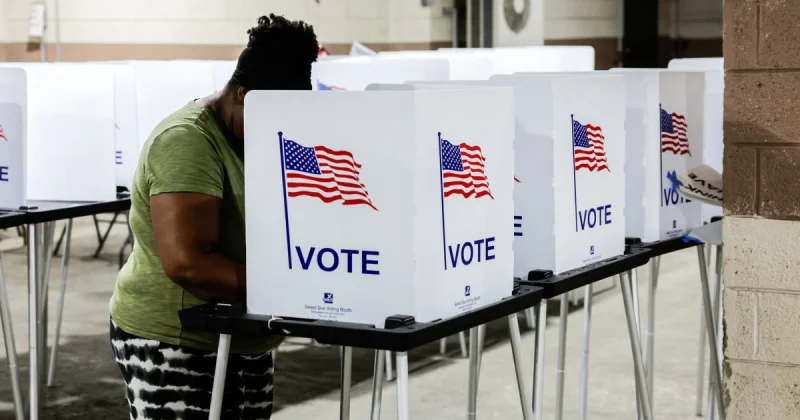
Polls closed Tuesday in part of Michigan, Missouri and Virginia as voters also cast ballots in Kansas, Michigan, Missouri, Virginia and Washington, and the biggest fight was in Michigan, where Democrats were choosing a nominee for an open Senate seat. The winner will face former GOP Rep. Mike Rogers in November.
That race has sharpened into a contest over who can build the broadest coalition, with Haley Stevens backed by retiring Sen. Gary Peters, Gov. Gretchen Whitmer and Senate Minority Leader Chuck Schumer, while Abdul El-Sayed has endorsements from Bernie Sanders and Alexandria Ocasio-Cortez. Recent polling has suggested the Black vote could matter more than any other bloc in the primary, and Stevens has consistently done better with Black voters than El-Sayed.
Three recent public polls showed El-Sayed leading by a wide margin when Black voters were set at about 20% of the electorate. An earlier Glengariff Group poll for the Detroit News and WDIV of Detroit told a different story: it put Black voters at about 30% of the primary electorate and had Stevens ahead by 7 percentage points. That gap has made turnout less of a side note than the central question in the race.

Federal scrutiny added another layer on Tuesday. The Justice Department monitored polling locations in four Michigan cities, and William Lawrence said that presence “absolutely does raise concerns.” He added that it looked like “a dry run and a fact-finding mission to interfere in a bigger way with the general election in November.” Matt Maasdam struck a similar note, saying the Trump administration was “trying to inoculate people to thinking this is normal, and it’s not.”
Harmeet K. Dhillon defended the effort, saying the Justice Department’s “primary monitoring efforts continue today as we seek to ensure free and fair elections nationwide.” She said the department was devoting “extensive resources to ensure uniform and nondiscriminatory monitoring” and thanked local jurisdictions for cooperation in “promoting trust and transparency.”
The stakes extend beyond the primary itself. The Michigan nominee will step into a general election against Rogers, and if the polling on Black turnout is right, Stevens’ path depends on whether the electorate looks closer to 20% or 30%. That makes the unanswered question tonight less about the size of the field than which version of Michigan’s Democratic electorate showed up when the polls closed.
