


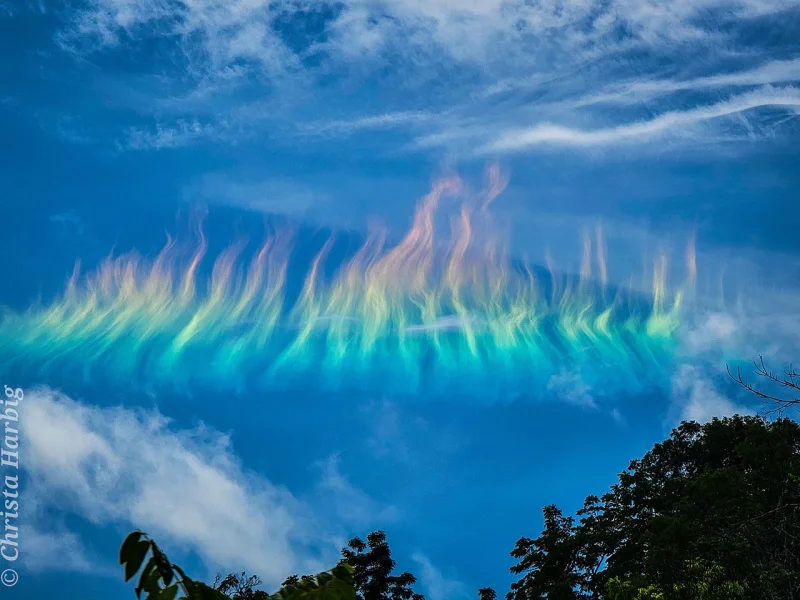
NASA has chosen a 2021 photograph of a West Virginia fire rainbow as the Astronomy Picture of the Day for August 2, 2026, giving Christa Harbig’s image a new audience years after she captured it near North Fork Mountain in West Virginia. The scene shows a circumhorizontal arc, the scientific name for the bright band that runs nearly parallel to the horizon.
The selection lands on a day when the image’s mix of color, rarity and timing does the work of explaining itself. NASA credited Harbig for the photo, and the choice highlights a phenomenon that looks dramatic enough to be mistaken for flame, even though it is neither fire nor the familiar rainbow formed by water droplets. The name fire rainbow sticks because the colors can look like burning streaks across a cloud, but the physics is different from an ordinary rainbow from start to finish.
NASA’s explanation points to a very exact set of conditions. The Sun must sit at least 58 degrees above the horizon, the clouds must be high cirrus fibratus made of thin, fibrous ice crystals, and those crystals must be flat, hexagonal and aligned almost horizontally. Inside that distant cloud, the ice crystals act like tiny floating prisms. When many of them share the same orientation, they bend sunlight in a similar way, splitting wavelengths at different angles and creating the luminous band.

That precision is why the sight is uncommon. All of those conditions have to come together at once: the Sun at the right height, the right cloud type, and the right crystal alignment. NASA’s caption summed it up simply: ice crystals and sunlight created a rare circumhorizontal arc above West Virginia.
The image itself carries the rest of the story. Harbig took it in 2021 near North Fork Mountain in West Virginia, and NASA later selected it for Astronomy Picture of the Day on August 2, 2026, a date that put an old photograph back into circulation as a fresh example of a rare optical effect. The APOD listing also names Robert Nemiroff, Jerry Bonnell, Cecilia Chirenti and Keighley Rockcliffe among its authors and editors.
What remains unanswered is why this particular image was the one NASA chose to spotlight. The case for it is easy to see: it is vivid, scientifically exact and uncommon enough to reward a second look. For viewers, the appeal is that the West Virginia fire rainbow is not a rainbow at all, but a brief alignment of sunlight, ice and geometry that most skies never manage to assemble.
