


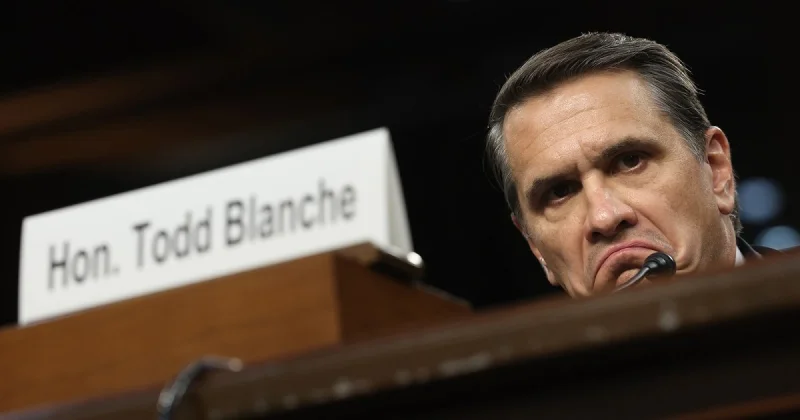
President Trump said he might pull Todd Blanche’s stalled nomination to be attorney general and bring it back later, after Senators John Cornyn and Thom Tillis are gone. The move put the nomination and Trump’s push for a $1.8 billion Slush fund on the same collision course.
Cornyn and Tillis were demanding assurances that the fund, meant to compensate Trump allies who believe they were wrongfully prosecuted, would be eliminated. That made the two senators the immediate leverage point in a fight that now reaches beyond one Justice Department post and into Trump’s wider effort to secure money for allies who say they were targeted.
That is why the story is landing now. Blanche’s confirmation was already stalled, and Trump’s own response suggested he was prepared to let the seat sit empty rather than back away from the fund. In practical terms, a withdrawal would not end the fight so much as freeze it, since a nomination can be sent back later if the White House wants to test the same Senate resistance again.

During a PBS discussion, David Brooks called the proposal a $1.8 million Slush fund before correcting himself to billion, then said, “All hail the king.” He added that “the government is there to serve the president, not to serve the government,” and later said Trump also wants immunity from prosecution from the IRS. Jonathan Capehart said he had expected Blanche to be confirmed by the time he returned from vacation, and described the $1.776 billion anti-weaponization fund as Republicans using Tillis and Cornyn as “human shields.”
The friction is plain. Trump appears willing to sacrifice his own attorney general confirmation if that is what it takes to preserve the fund, while two Republican senators are holding the line and asking for the opposite outcome. Blanche’s nomination has become a bargaining chip, not a standalone personnel choice, and Cornyn is one of the senators forcing that reality into the open.
The unresolved question is not whether the standoff is real. It is whether Trump will actually withdraw Blanche’s nomination, and whether Cornyn and Tillis will keep enough pressure on the fund to make that worth doing. If he does, the fight simply moves to the next round.
Brooks tied the moment to Trump’s larger view of power, including his claims about the 2020 election and January 6, while the Democratic National Committee was moving ahead with its own 2028 primary calendar plan. South Carolina was set to go first, followed by Nevada and another state, a reminder that both parties are already making choices that will shape the next presidential cycle.
