


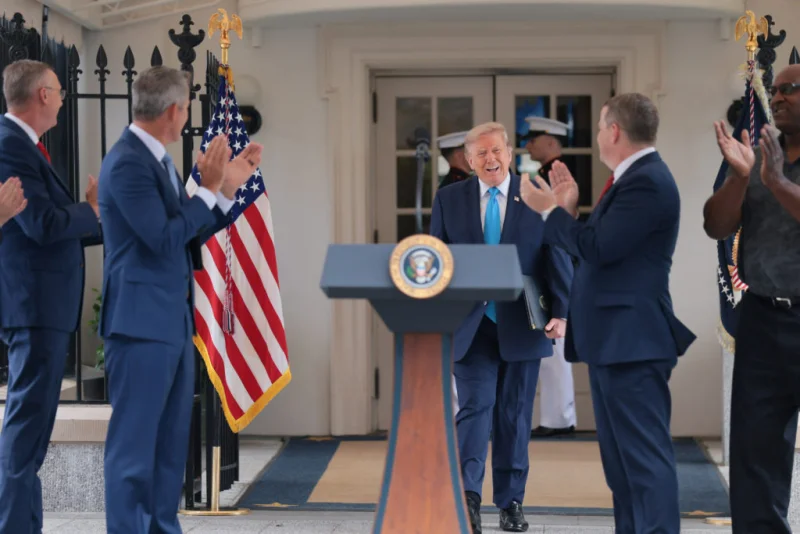
President Donald Trump will launch the White House’s new Freedom Haulers initiative on Thursday, opening a faster route for military veterans to get commercial driver’s licenses while the administration presses ahead with a tougher crackdown on illegal immigrant and non-English-speaking truckers.
The announcement is set for West Executive Avenue, where Trump will be joined by Department of Transportation Secretary Sean Duffy, Veterans Affairs Secretary Doug Collins and Acting Labor Secretary Keith Sonderling as they welcome a truck to mark the rollout. For veterans, the most immediate change is practical: the Department of Transportation will expand eligibility for expedited CDL processing, extend the waiver period from 12 months to 24 months after active-duty service, and offer training to veterans who never drove a heavy commercial vehicle in uniform.

That push is meant to turn military driving experience into a civilian job path without forcing veterans to start from scratch. White House spokesperson Anna Kelly said the administration has made roads safer by taking illegal alien, non-English speaking truck drivers off America’s highways, and she framed Freedom Haulers as part of a broader effort to help veterans move into good-paying work in trucking, an industry that keeps goods moving through America’s supply chains.
The timing also reflects a harder edge inside the same campaign. Before Thursday, multiple fatal truck accidents involving illegal immigrants had intensified safety concerns on American roads, and ’ Kevin Corke reported on a joint investigation by the Department of Homeland Security and the Department of Transportation into truck driver schools. That probe centers on improper certifications and falsified records tied to commercial driver’s licenses issued to non-citizens, giving the administration a safety argument to pair with its labor push.
Indiana and Wyoming are also set to join the Federal Motor Carrier Safety Administration’s Even Exchange program, which is designed to make it easier for military truck drivers to move into civilian CDLs. Taken together, the changes point to a two-track approach: tighten enforcement around who gets behind the wheel while widening the lane for veterans who already know the work. What remains unclear is how many veterans will qualify quickly enough to matter at scale once the new process begins on Thursday.
