


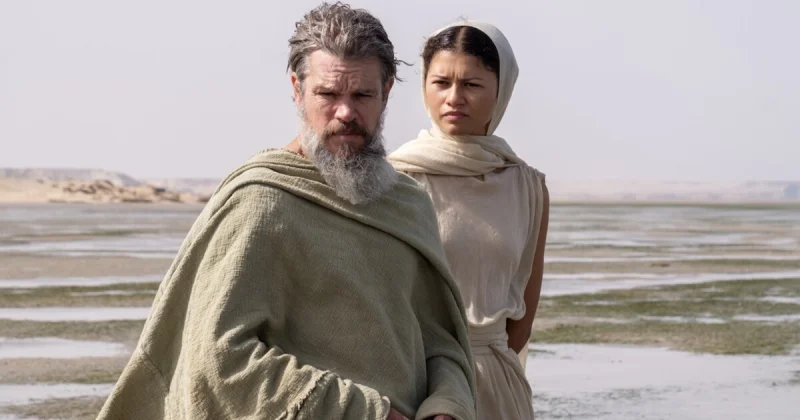
Emily Wilson has weighed in on Christopher Nolan’s $250 million action movie version of The Odyssey, and her verdict is blunt: it is entertaining, but it does not reach much deeper than the surface. She says the film can carry a viewer through a few hours of heat and that Nolan’s trademark jumps and twists are relatively easy to follow.
That makes the review easy to understand in the way readers are already looking for it now. This is a major adaptation of Homer’s ancient poem, and Wilson argues that it is built to be watched as a family-friendly audiovisual spectacle rather than felt as a serious emotional journey. In her reading, The Odyssey is not boring because the source material is doing much of the work. The film is, as she puts it, very good at big bangs and big giants.
Wilson’s point is not that Nolan missed the scale of the story. It is that the scale is doing almost all the labor. She describes the movie as an elaborate Fourth of July fireworks display, with about the same depth of narrative and emotion. That is where the praise and the criticism sit side by side: the film is lively, readable and built for general audiences, but it also carries Nolan’s familiar mix of grandiosity and superficiality.

The contrast matters because Wilson also reminds readers that Homer’s poem was already an adaptation. It used the written alphabet to reshape older mythical traditions and recast a veteran’s homecoming for Greek-speakers in the archaic period. She notes that some seventh-century BCE Greek communities were ruled by an oligarchy and some by a single man, and that the poem works through the tension between groups of men and one powerful, cunning figure. In that light, a modern action version is not automatically a betrayal. The harder question is whether this one keeps the poem’s nerve.
That is where the review grows sharper. Wilson says the film’s vision is too confused, and its characters too underdeveloped, to deliver what it half-promises in terms of big ideas. The emotional register stays flat even when the images get larger. Her response to Argos the dog shows the same pattern: the adorableness of a puppy is predictably amped up for animal-loving times, but the effect is still more calculation than surprise.
She does not dismiss the cast. Himesh Patel plays Eurylochus, Odysseus’s doomed right-hand man, and Matt Damon plays Odysseus. But the review treats performances as part of a machine designed to move fast and look expensive, not as the place where the film earns its meaning. Wilson also says The Odyssey is impossible to make entirely dull, which is another way of saying the poem’s own structure keeps rescuing the movie from itself.
The result is a review that leaves Nolan’s film with a clear identity: a polished, accessible spectacle that knows how to stage enormous images, but not how to make them land with much feeling. For viewers, that is the key question now. If they go looking for Homer’s emotional force, they may find an action movie that keeps the shapes of the story while flattening what made it endure.
