


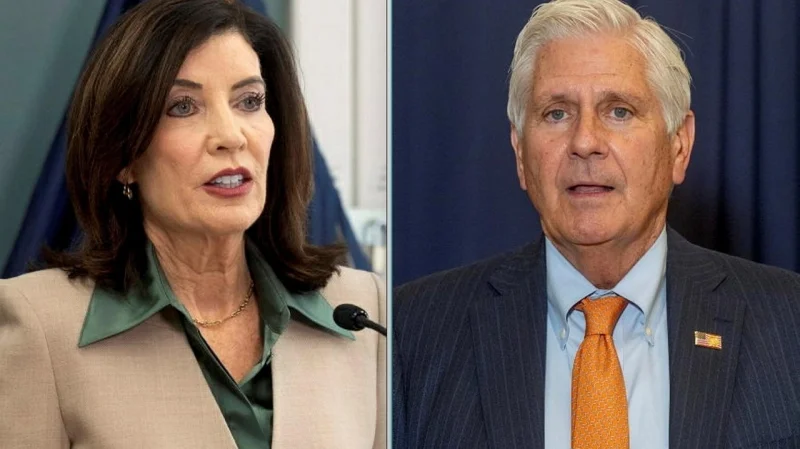
U.S. Immigration and Customs Enforcement is quietly increasing the number of detention centers it runs across upstate New York even as President Donald Trump’s border czar has said more than once that a surge of ICE agents is coming to New York City. The buildup puts immigration enforcement squarely inside the race for governor, where Kathy Hochul and Bruce Blakeman are already clashing over how far New York should go in working with ICE.
The timing matters because the campaign is moving toward its fall peak, and the state’s immigration fight is no longer abstract. Blakeman has signed an agreement to deputize 10 Nassau County police officers as ICE agents and says Nassau County is renting space in the county jail for ICE detainees. He has argued that working with ICE makes a surge unnecessary, saying his county has removed many illegal migrants with criminal records for rape, robbery and other heinous crimes without raiding schools, churches or daycare centers.
Hochul went the other way in May, when she signed a bill banning the kinds of agreements Nassau and several other counties have already signed. That split is now part of the campaign’s political wiring. The governor has said Trump told her there will not be a surge of ICE agents in the state unless she asks for one, and she has made clear she is not looking to request it.
She repeated that position Monday in Buffalo, telling Tom Homan to talk to “the big boss” because she is not giving that invitation nor that permission. It was a pointed line, but it also underscored how much the issue has shifted from policy to politics. A Siena University poll last month found only 9% of respondents named immigration when asked which issue concerned them most, which suggests the subject is not yet dominating everyday voter priorities even as the enforcement machinery grows around it.
There is still a gap between the warning and the reality. ICE has not said how many detention centers it is adding or expanding across upstate New York, and there is no confirmed start date for any New York City surge. That uncertainty is part of what makes the story so combustible: if a larger deployment arrives, it would land in a state where the governor has already drawn a legal line, one county is openly cooperating, and the politics of the whole fight could harden fast.
Grant Reeher of Syracuse University said physical proximity always matters and that something in New York would focus attention in New York for a while. He noted that people are still talking about the issue in Minnesota, a reminder that immigration enforcement can linger long after the first headlines fade. In New York, the question now is not whether ICE has become more visible; it is whether the buildup stays quiet or turns into the defining confrontation Hochul and Blakeman cannot avoid.
