


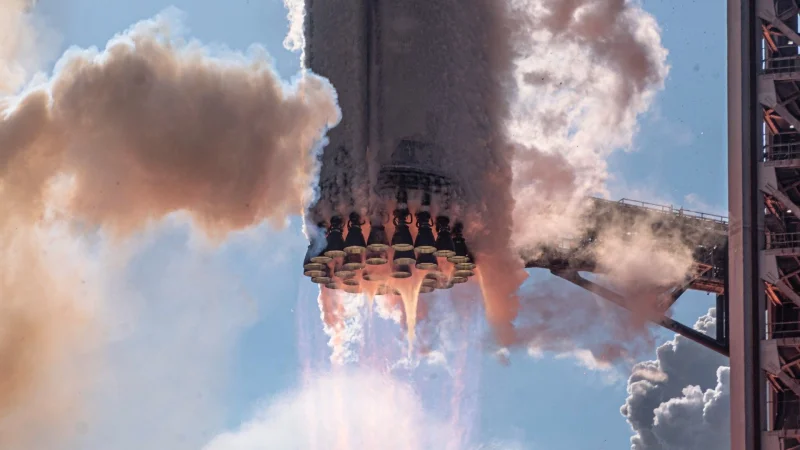
SpaceX retargeted Starship Flight 13 for Friday evening, July 24, after waiving off a launch attempt on Thursday because of weather. The next try was set to open in a 90-minute window at 5:45 p.m. CDT, or 6:45 p.m. EDT, as the company kept working toward its second attempt to fly the giant Starship-Super Heavy system.
The timing matters because the flight was not a routine retry. It came after days of work replacing and testing multiple Raptor engines on the Super Heavy booster, work that followed a post-ignition abort on July 16 when on-screen telemetry showed four engines that apparently did not ignite. Elon Musk said at least two Raptor engines had to be removed after the hard engine stop, underscoring how much of the week was spent making Booster 20 ready to try again.
By the time SpaceX aimed at Friday evening, the vehicle stack had already been through a fast reset. Ship 40 was de-stacked from Booster 20 in the pre-dawn hours of Friday, July 17, then returned to the production site at Starbase. Booster 20 was rolled back later that day, brought back to Pad 2 on Tuesday, July 21, then loaded with liquid oxygen and liquid methane on Wednesday before being drained again. By Wednesday night, Ship 40 was back on the pad and stacked atop the booster once more.

SpaceX said additional preflight testing on Super Heavy was complete before preparations to launch Starship were to begin as soon as Thursday, July 23. Weather interrupted that plan. The waiver-off did not change the mission itself, but it did push the launch attempt to the next available evening window and left the booster stack waiting through another delay. In a test program built around short opportunities, a lost day is not just calendar drift; it is another round of countdown, weather review and vehicle readiness checks.
Flight 13 was built around more than just getting off the pad. One main objective was to deploy 20 Starlink V3 satellites from Ship 40, with SpaceX saying the satellites would extend solar arrays and antennas, try to link with the larger Starlink constellation through high-capacity lasers, and then demise about 20 minutes after deployment. The company also planned a Raptor engine relight after the roughly 11-minute deploy sequence, hoping the work done on the sea-level engines and the updated startup sequence on the upper stage would help produce a successful boostback burn on Booster 20 and a splashdown in the Gulf of Mexico.
That is the part that gives Friday’s window its edge. SpaceX has said the Super Heavy on this flight carries hardware modifications to improve relight reliability, along with updated engine alarms and abort logic to match a multi-engine flight environment. It is the clearest sign that the company is treating Flight 13 as more than a simple rerun of Flight 12, where the startup sequence on Ship 39 left the booster’s directional flip off by about 90 degrees and five of 33 sea-level engines prevented a nominal boostback burn. Booster 19 was lost in that flight, and the upper stage heat shield remains part of the broader reusability work.
If Friday’s attempt lifts off inside the evening window, SpaceX will have turned a weather delay and a week of repair work into a fresh shot at one of its most demanding tests yet. If it does not, the unanswered question is not whether the program has moved on. It is how much more engine work the booster can take before the next window opens.
