


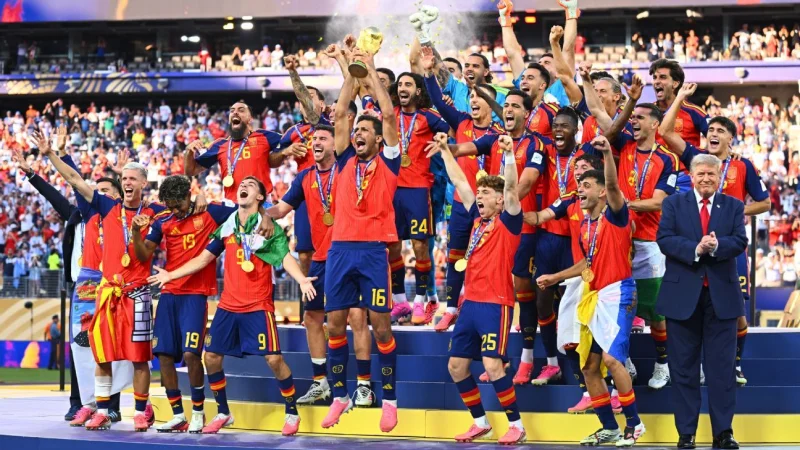
Spain won the 2026 FIFA World Cup and, with it, became the first country in history to hold the men's and women's World Cup trophies at the same time. Kylian Mbappé finished with the Golden Boot after beating Lionel Messi and Jude Bellingham, a clean ending to a tournament that kept delivering on the field.
That is why the search is spiking now. The result settled the title, but it also put a neat historical marker on a World Cup that had been defined by big moments from the start: the top four teams reached the semifinals, and the tournament kept finding ways to make even familiar outcomes feel unusually large.
For fans and teams alike, the tournament kept producing scenes that traveled fast. Canada won its first knockout game. Mexico won a knockout game and then pushed England to the end in a match many treated as a contender for game of the tournament. The United States also had a milestone run, winning three matches in a World Cup for the first time and scoring a program-high 11 goals.
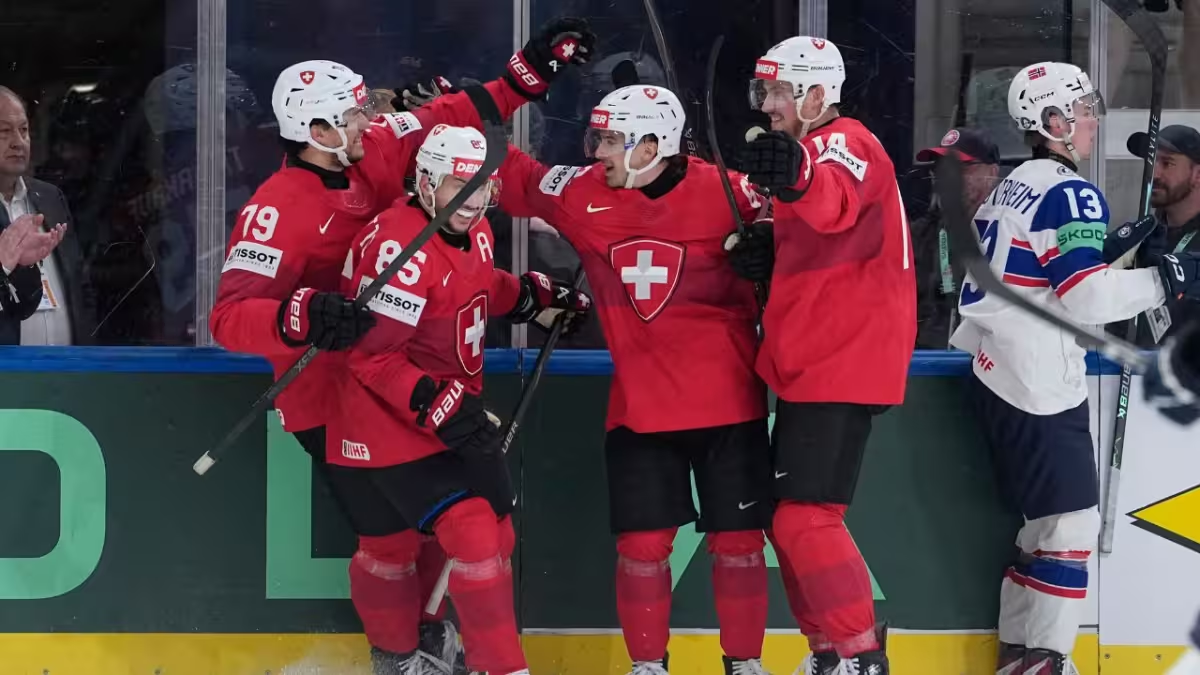
One of the most replayed images came after the United States beat Australia in Seattle, when players and fans sang “Country Roads.” Erling Haaland also helped spread Norway's seafaring ceremony far and wide, adding another moment that stood out because it felt specific to the crowd, not scripted for television.
But the tournament was never only about the scoreboard. It was packed with ticket prices, politics, money grabs and hydration breaks during indoor matches, and those details sat uneasily beside the action. FIFA's lack of transparency was raised over the legitimacy of a VAR review and over whether a sitting president influenced a player's suspension, which left a different kind of question hanging over some of the same matches that produced the loudest cheers.
That was especially sharp in the case of Folarin Balogun, whose clearance to play was reportedly helped along by President Donald Trump and the American government despite an automatic suspension. It was a reminder that the tournament's cleanest sporting story lines were moving alongside disputes that were anything but clean.
In the end, the 2026 FIFA World Cup gave Spain a historic title and Mbappé a scoring crown, while the fan scenes and off-field fights made the tournament feel bigger, messier and more revealing than a simple champions list. The part that still needs answering is not who won; it is how much of the next World Cup will be judged by the play itself and how much by everything that happened around it.
