


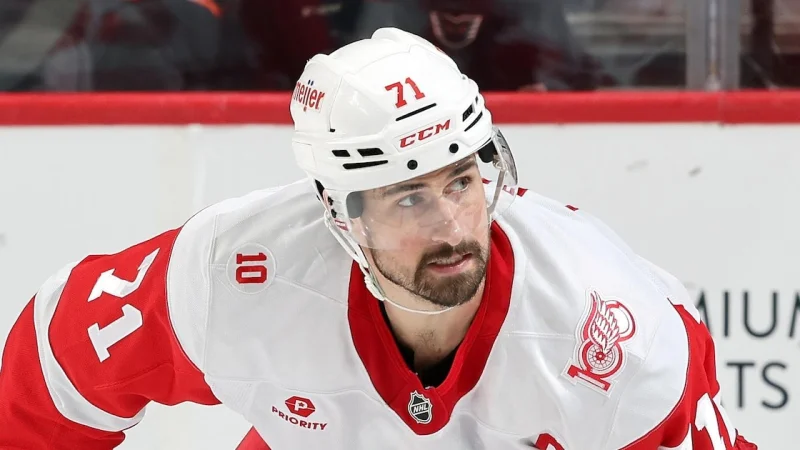
Dylan Larkin has asked for a trade out of Detroit, and he has narrowed the list of teams he would accept to four: the Minnesota Wild, Dallas Stars, Vegas Golden Knights and Florida Panthers. Because his extension includes a full no-trade clause, the Detroit Red Wings cannot move their captain unless he says yes.
That is why this is being watched now. Larkin has five years left on an $8.7 million cap hit, which means any deal would have to clear both a long contract and a limited approval list. For Detroit, the search is not about whether a star can be moved in the abstract. It is about whether one of four clubs would be willing to pay enough for a player who still has years of control and can shut the door on every other destination.
The four-team list also helps explain why the market is so tight. The Dallas Stars already have major money tied up with Roope Hintz, Wyatt Johnston, Thomas Harley and Miro Heiskanen, while Jason Robertson is expected to be signed before the season starts. Mikko Rantanen carries a $12 million cap hit, Tyler Seguin has knee issues and a $9.85 million cap hit, and Mavrik Bourque was moved to Nashville to make room for Robertson’s next contract. That is the shape of a team that can like a player and still struggle to fit him in.

Vegas brings a different kind of complication. Jack Eichel is one of Larkin’s best friends, which makes the Golden Knights an obvious destination on paper, but they also have their own math to solve. Tomáš Hertl’s contract only allows trades to three teams, Vegas has two first-round picks in 2028, and it does not have a first- or second-round pick in 2027. That means even the club with the cleanest personal connection may not have the draft capital Detroit would want.
Steve Yzerman does not have to move quickly just because Larkin made his request. He is the Detroit Red Wings general manager, and he is not being pushed into a decision simply because the player controls the no-trade clause. The result is a standoff built on leverage on both sides: Larkin can block destinations, and Detroit can wait for a return that actually matches five years of control on an $8.7 million cap hit.
If the asking price is too high, nothing happens. If it comes down, the only realistic door is one of the four clubs already on Larkin’s list. Until then, Detroit is holding the asset, Larkin is holding the veto, and the market is trapped between them.
