


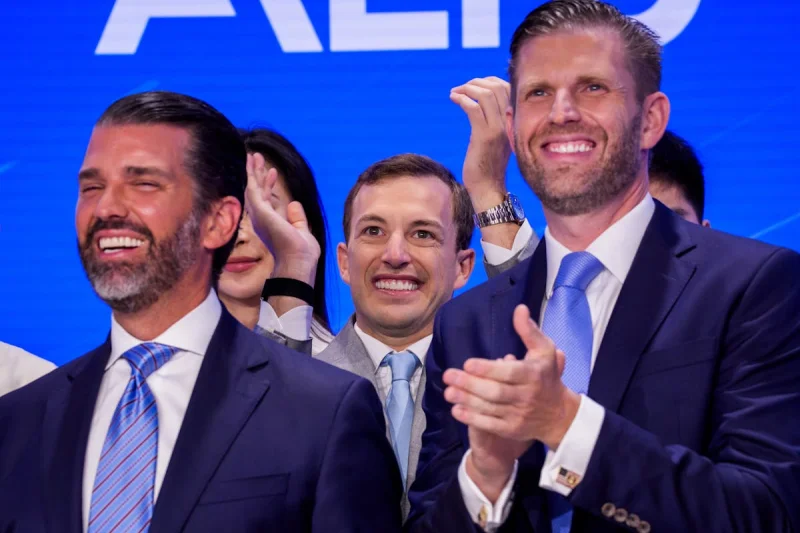
Investment funds associated with Donald Trump Jr. and Eric Trump put money into more than a dozen defense tech companies and other firms seeking business from the Pentagon and federal agencies, and those companies later won at least $3.2 billion in federal contracts. They also secured $3.1 billion in future contract options, giving the investments a payoff that reaches far beyond the initial deals.
The analysis from The Washington Post lands at a moment when readers are already watching how money, politics and military spending overlap. Under Joe Biden, a ramped-up approach to military spending began, and under Trump it escalated significantly, creating a larger pool of defense work for companies that could win preapproved contractor placement and, in some cases, exclusive access to bid on up to nearly $200 billion in future work.
That is what makes the numbers matter. The companies did not just receive one-off awards; some gained entry to shortlists that can shape who gets invited to compete next, turning the original investments into a potential pipeline of government business. By the time the contracts and options are counted together, the total tied to the companies rises to at least $6.3 billion.

Spokespeople for the administration, the Trump brothers and the defense contractors rejected the conflict-of-interest concerns that followed. They said the contracts were awarded solely on merit and that there is no corruption afoot. That denial leaves one hard question untouched: which firms were helped most directly by the money, and how much of the federal business came after the investments rather than before them?
The broader backdrop is familiar. The story fits a pattern of Donald Trump's family benefiting financially while he is in the White House, this time through defense technology and federal contracting rather than a more visible political fight. For now, the paper trail shows money going in and contracts coming back out. It does not show a formal inquiry or any step that would settle the conflict-of-interest argument.
The same reporting package also turned to Mitch McConnell, who said he was briefly unconscious, taken to the hospital and later moved to a rehabilitation facility after being found unconscious in his Washington residence on June 14. McConnell said he did not break any bones or suffer a concussion, and that he had a mild case of pneumonia, while a photo released by his office on Sunday prompted online speculation from Laura Loomer and Jason Chaffetz. His condition appears medically explained, but the questions around the photograph show how quickly public suspicion fills any gap when officials do not provide moving evidence.
