


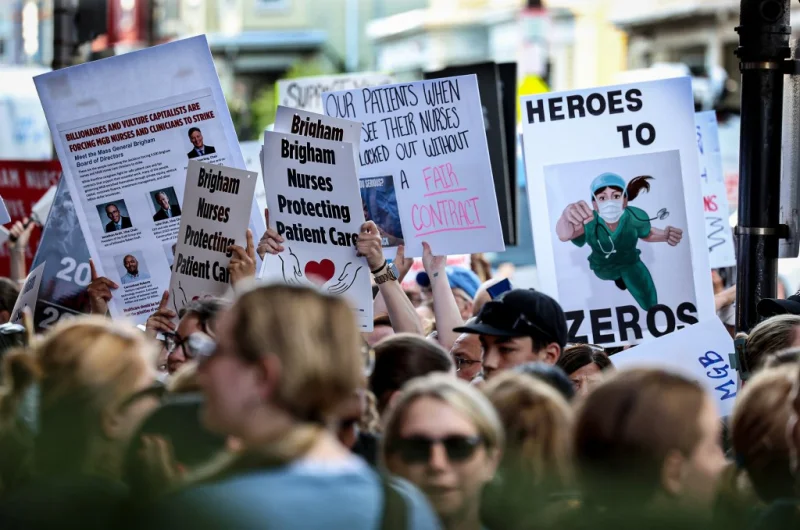
Brigham and Women’s Hospital nurses are set to walk back into work Monday after the Mass General Brigham nurse strike and the lockout that followed it, ending a stoppage that stretched far beyond the one-day strike itself. The nurses planned to gather before 6:59 a.m. for a brief rally, then head inside.
The return marks the first concrete reset in a dispute that began Wednesday, when contract talks broke down and Massachusetts Nurses Association members voted to strike. By Thursday morning, the 4,000 Brigham and Women’s Hospital nurses had finished their one-day strike, but Mass General Brigham answered with a four-day lockout that kept the work stoppage going at Brigham and Women’s Hospital and MGB Home Care sites. The hospital said the move was needed to allow for extensive operational and emergency preparedness measures.
The reason this fight has drawn so much attention is not just the scale of it, but the money at the center of it. Dr. Anne Klibanski, the president and CEO of Mass General Brigham, earned $8.4 million in 2023, according to the last 990 tax forms posted on Guidestar. At the other end of the same system, the highest-paid nurse at Brigham and Women’s Hospital earned $412,299 in 2025. The next 10 nurses on the list all took home $300,000, with one topping out at $358,175, and all of the rest in the top 100 nurse list made more than $237,000 last year.

Joe Markman said that still misses what nurses are asking for. He said they want a cost-of-living bump and that the current 0% cost-of-living offer just is not working. He said the cost of living in Massachusetts rose 50% from 2020 to 2024 and is still climbing, and warned that without a real raise, wages will fall behind. The union has framed the issue as one of keeping pace with a high-demand market, while Mass General Brigham has said it values its nurses and pointed to the pay levels of its highest earners.
That split is what has made the dispute so hard to settle. Governor Maura Healey, Boston Mayor Michelle Wu and U.S. Sen. Ed Markey all joined the picket line last week, underscoring how politically visible the fight has become. Markman also said Dana-Farber and MGB are competing for hundreds of oncology nurses over the next few years and that other hospitals are raising wages to keep pace, a reminder that this is not only about one contract but about who keeps the region’s nursing staff in place.
The immediate answer is that the nurses are coming back Monday, but the larger question remains open: whether the sides have actually moved any closer to a deal. The stoppage ends for now, yet the contract dispute that triggered the state’s largest-ever nurses’ strike does not appear to be settled.
