


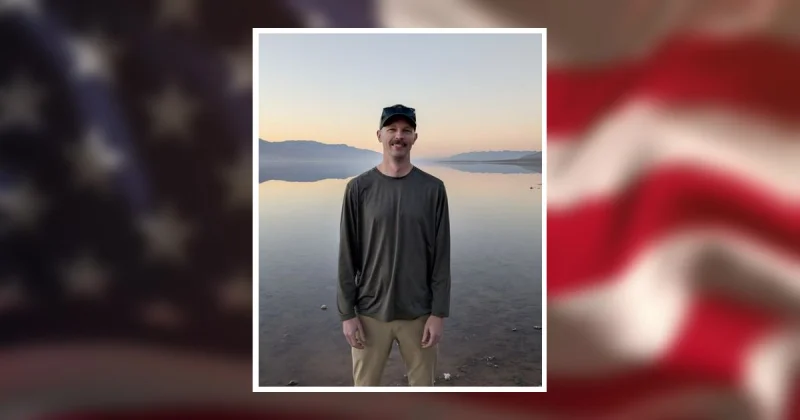
Flags are at half mast today because Major Brad Hovey, a 35-year-old United States Air Force experimental test pilot, died June 15, 2026, during a B-52 flight test mission at Edwards AFB. His death has put a quiet, sudden end to a career built on combat flying, test work and years spent leading from the cockpit.
For readers searching why are flags at half mast today, the answer starts with the scale of the loss. Hovey had logged more than 1,890 total flight hours, more than 350 sorties across 29 distinct airframes, and served 12 years in the Air Force. He was also a husband and father; the obituary identifies Megan as his wife and says he had two children. He met Megan in ninth grade band, and the couple married in Iowa in 2012.
Hovey’s path to Edwards was long and exacting. Born in Algona, Iowa, on March 5, 1991, he lived in Casper, Wyoming, for three years before moving to Adel, Iowa, in 2001. He graduated from Adel DeSoto Minburn High School in 2009, earned Scouting’s highest rank of Eagle with Adel Troop 152, then went on to Iowa State University, where he excelled in Aerospace Engineering and Air Force ROTC with Det. 250. He graduated in 2014 and began USAF Pilot Training at Vance AFB the same year.

From there, Hovey’s career moved through the kind of assignments that built him into a bomber pilot and then a test pilot. He earned his wings in 2015 as a member of Class 16-02, began B-52 initial qualification training at Barksdale AFB in Louisiana, and later went to the 69th Bomb Squadron at Minot AFB in North Dakota. He flew, instructed and led with the Knighthawks for six years before moving with his family to Edwards AFB in 2022 and attending the USAF Test Pilot School with Class 23A.
The part that does not fit neatly into the tribute is the death itself. Hovey was described as cool under pressure and tenacious, the sort of pilot colleagues trusted when a mission grew difficult. Yet he died during a flight test mission, a reminder that even the most disciplined aviators work in an environment where precision can never erase risk. No further official update has been confirmed here on what caused the fatal mission, and that unanswered point now hangs over a career defined by control, judgment and discipline.
What is clear is that the flags at half mast mark more than one death. They mark the loss of a pilot whose service ran from combat deployments to test work, and of a father and husband whose family now carries the story forward. The next question is not whether the honor is warranted; it is whether any official account will explain how a mission flown by such an experienced pilot ended in tragedy.
