


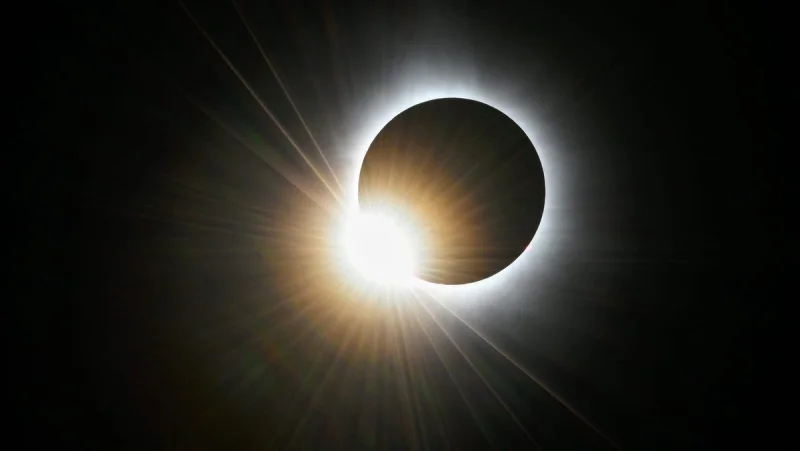
A total solar eclipse is set for Aug. 12, but people in the U.S. will not get the full show. The moon will pass between the sun and Earth at about 11:34 a.m. ET, and totality will be visible only along a narrow path across Greenland, Iceland, northern Russia, Spain, a part of Portugal and the Atlantic Ocean.
That is why the search for this eclipse is spiking now: it is close, it has a fixed time, and it will be seen differently depending on where a viewer stands. Areas of the U.S., from Alaska to North Carolina, will be able to see only a partial solar eclipse, and Canada, Europe and northwestern Africa will also be in that partial-view zone.
A solar eclipse happens when the moon moves between the sun and Earth and blocks the sun’s face either fully or partially. A total solar eclipse is rare because only the path of totality gets the sun completely covered. That is also why the event happens only about once every 18 months, even though partial eclipses are much more common. The last total solar eclipse was on April 8, 2024.

The practical difference matters. During totality, the sky darkens and viewers can remove their eclipse glasses. Outside that narrow path, people should never look at the sun with the naked eye. Eclipse glasses or handheld solar viewers should meet ISO 12312-2, and that rule applies to anyone watching the partial eclipse in the U.S. or elsewhere.
The part that makes this eclipse feel bigger than the map suggests is also what limits it. The headline event is totality, but the U.S. is not on the path that gets it. For American viewers, the spectacle is partial, not total, even as the celestial geometry places a full eclipse over Greenland, Iceland, northern Russia, Spain, a part of Portugal and the Atlantic Ocean.
The next mark on the calendar comes the night after the eclipse, when the Perseid meteor shower peaks during the new moon. For now, the Aug. 12 total solar eclipse at 11:34 a.m. ET is the one to watch — carefully, and with the right glasses if you are outside the path of totality.
