


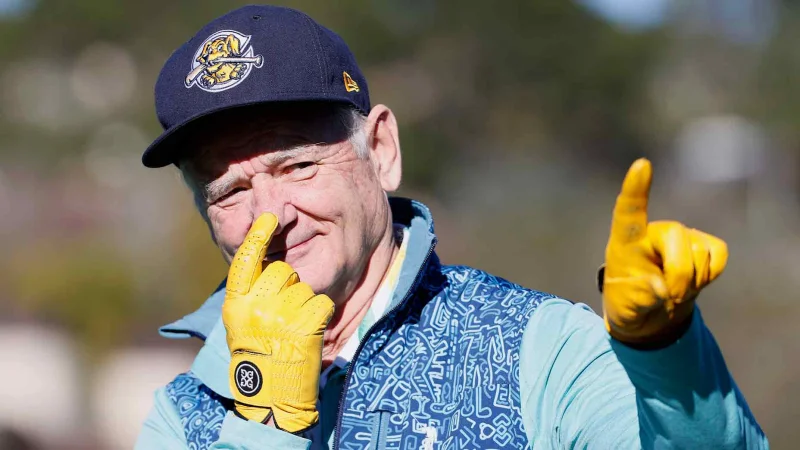
Bill Murray opened the first night of the L.A. Phil’s three-night Wes Anderson tribute at the Hollywood Bowl on Friday, serving as the evening’s MC as the program turned the director’s music into the main event. Wes Anderson also made a brief appearance onstage with Murray, but the spotlight quickly shifted to the songs and scores that have shadowed his films for nearly three decades.
The show was built around music from Anderson’s work, with Justin Meldal-Johnsen as musical director and a backing band that included Roger Joseph Manning Jr., Jason Falkner, Joey Waronker and Gus Seyffert. The L.A. Phil played scores by Alexandre Desplat and Mark Mothersbaugh, while Jean-Yves Thibaudet performed “Moses Rosenthaler” from The French Dispatch, Rajib Karmakar and Aakash Pujara played sitar and flute drones from The Darjeeling Limited, and Kaoru Watanabe played “Shinto Shrine” from Isle of Dogs. Beck, Jackson Browne and Devo were among the artists set to take part over the three nights, a lineup that fits Anderson’s reputation for treating music as part of the architecture of his films rather than decoration after the fact.

That was the point Jason Schwartzman kept coming back to when he stepped onstage. He said Anderson played him the entire soundtrack for Rushmore in the director’s car when Schwartzman was a teenager, then walked him through the whole movie in narration before a frame had been shot. Schwartzman also said he found a cassette tape at his mother’s house labeled “Rushmore songs,” pulling it from his pocket and tossing it into the audience on Friday after telling the crowd, “This is the soundtrack to the movie. This is the order it’s going to be in,” and, “I was at my mom’s house tying my shoe, and I see a cassette tape on the ground titled ‘Rushmore songs.’”
The tribute’s music-first framing did not soften the deeper point of the night. Anderson’s films are so closely built from soundtrack choices, original scores and pre-shot planning that the concert felt less like a retrospective than a live demonstration of how controlled his work has always been. With Friday’s performance only the opening night of a three-night stand, the remaining question is not whether the Hollywood Bowl can sell the idea of Anderson’s music — it already has — but how far the next two nights can go in showing the same precision in a room full of performers and a crowd listening for the details.
