


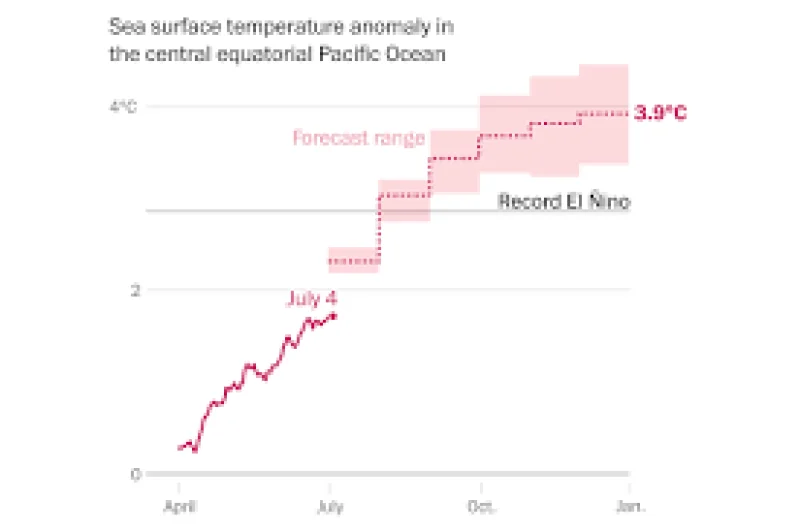
NOAA said warming conditions were taking hold in the Pacific last month, and it put the odds at 63% that sea surface temperatures will rise more than 2C above normal later this year. That is the kind of shift that can tip El Niño into a powerful phase, and scientists now see a historically unprecedented chance that the 2026-27 cycle develops into a very strong event.
That is why Los Angeles Weather is getting attention now: a warmer Pacific can alter rainfall, temperature and harvest patterns far beyond one coastline, and the market is already trying to price the risk. Goldman Sachs said the same El Niño could lift global food commodity prices by 15.8% and push eurozone food prices up 1.3%, with the effects not fully working through until the second half of 2028.

El Niño forms when wind patterns shift and allow warmer water to spread across the central and eastern equatorial Pacific. In plain terms, it is the ocean-atmosphere coupling that can rearrange weather far from the Pacific basin, which is why food traders, growers and governments watch the threshold so closely. The strongest recent episodes in 1981-82, 1996-97, 2015-16 and 2023-24 showed how quickly that pattern can become a global price event.
The numbers also show where the first pressure points may appear. UniCredit said El Niño could add a new layer of pressure later this year, while UBS said it does not hit agriculture uniformly and instead creates regional winners and losers. That matters because warmer conditions may help some areas even as harvests elsewhere come under strain, which is the part of the story that never fits a simple global warning.
For now, the immediate trigger is not a finished event but a growing signal in the Pacific, and that is enough to keep food markets on edge. Goldman Sachs said a super El Niño this year could deliver a severe shock to global food prices lasting into 2028, while the Iran war is already pushing world food prices to a three-year high and supply chains are facing two shocks at once. The next question is not whether the pattern can move markets, but whether the Pacific warming now taking hold is the start of a strong 2026-27 event or only the opening act.
