


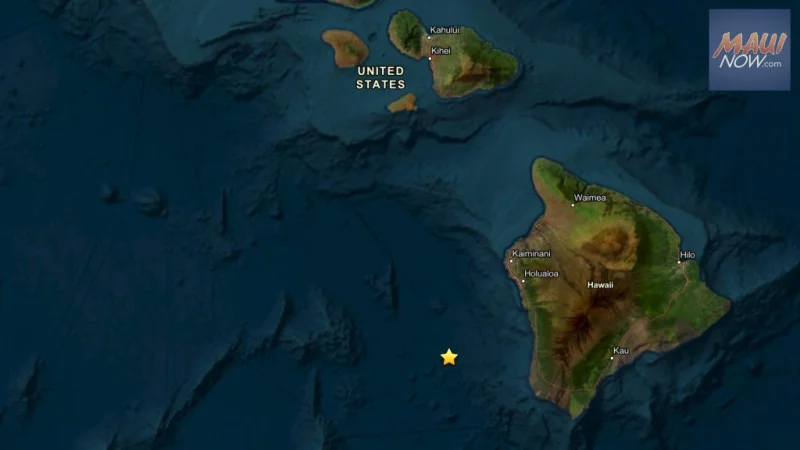
USGS says the recent shaking felt across Island of Hawaiʻi was driven by deep earthquakes, not by magma moving underground. The agency tied the most recent widely felt quakes to lithospheric flexure, the bending of the rock layer under the islands as it carries the weight of Hawaii.
That explanation matters now because residents have had several reasons to notice the ground move in a short span. A magnitude-6.0 earthquake on May 22nd struck beneath the west side of the Island of Hawaiʻi, southeast of Captain Cook, at a depth of 14 miles below the ocean surface. Two more followed: a magnitude-4.6 event on June 2nd northwest of Keauhou at 21 miles deep, and a magnitude-4.7 quake on June 9th east of Pepeʻekeo at 24 miles deep.
These are not the shallow, everyday quakes people often associate with volcanic systems. Most of Hawaii’s day-to-day seismic activity occurs within those systems, but deep earthquakes like these have been recorded since the U.S. Geological Survey’s Hawaiian Volcano Observatory began monitoring Hawaii’s volcanoes in 1912. Hawaii sits in the middle of the Pacific plate, so it does not produce the kind of seismicity that comes from plate-boundary interactions.

The deeper cause is mechanical. Volcanism in Hawaii comes from a mantle plume near the core-mantle boundary, while the Pacific plate moves northwest over that stationary source and builds the island chain over time. As the chain grows heavier, the lithosphere bends downward under the load. The weight is greatest beneath Mauna Kea and Mauna Loa, and about 100 miles offshore the same rock layer flexes upward into what is known as the Hawaiian Arch. Deep faulting forms as that flexure stresses the crust.
That is the part that can be easy to miss when the shaking is widely felt. These earthquakes happen in a volcanic region, but they are not directly tied to magmatic processes. The difference matters because a felt quake does not automatically mean a volcano is moving toward an eruption. It can mean the islands themselves are flexing under their own mass, with shaking that spreads across Hawaii even when the source is far below the surface.
For now, the recent pattern points to a familiar feature of life on the islands rather than a new volcanic signal. The next thing readers need to watch is not a fresh magma warning, but whether the cluster of deep quakes gives way to more of the same kind of offshore and deep shaking that Hawaii has recorded for generations.
