


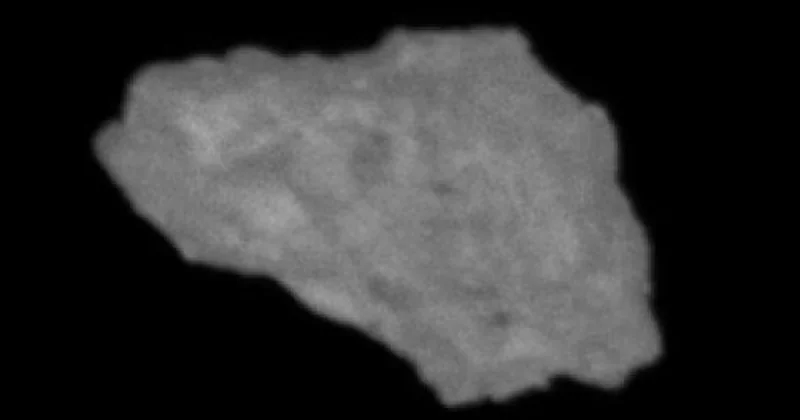
Tianwen-2 has sent back its first image of Kamo‘oalewa, the near-Earth asteroid it reached after about 400 days in flight. The picture marks a fresh milestone for a mission that is now closing in on sample collection from a rock only about 66 feet across.
The China National Space Administration said the probe was about 12 miles from the asteroid in late June, after a trip that covered roughly 621 million miles since launch on May 28, 2025. For readers following Tianwen-2, the image is the clearest sign yet that the spacecraft has moved from cruise phase to close-up work around its target.
Kamo‘oalewa is not a normal companion to Earth. It is a quasi-satellite that loops around the sun while staying close to Earth, coming as near as 9 million miles and as far as 25 million miles away. Astronomers have identified eight such space rocks that seem to follow Earth’s path, and some scientists call them mini moons or quasi moons. Kamo‘oalewa itself was discovered in 2016 and spins once every 28 minutes.

What makes the asteroid especially interesting is its origin story. Some research has suggested it may be a stray piece of the Moon thrown into space by an ancient impact, but that idea is not settled. Other evidence, including observations from the James Webb Space Telescope, disputes that theory. That disagreement is part of why a sample-return mission matters now: the spacecraft can do more than photograph the object; it can test what the rock is made of and where it came from.
The mission is expected to move step by step from imaging to closer scientific study, with the probe gathering data on the asteroid’s shape, material composition and internal structure before any sample is taken. Tianwen-2 may use a touch-and-go method, an anchor-and-attach approach or a hovering technique with a robotic arm. The most practical choice will likely depend on how the surface responds at close range, since a small body with weak gravity and a fast spin can make sampling more complicated than it sounds.
After the samples are brought back to Earth in 2027 and dropped into Earth’s atmosphere during a flyby, the spacecraft is set to head on to comet 311P/PanSTARRS for further observations and scientific study. For now, though, the first image tells the public that Tianwen-2 has reached the hard part of the mission: the place where a distant target becomes a working destination.
