


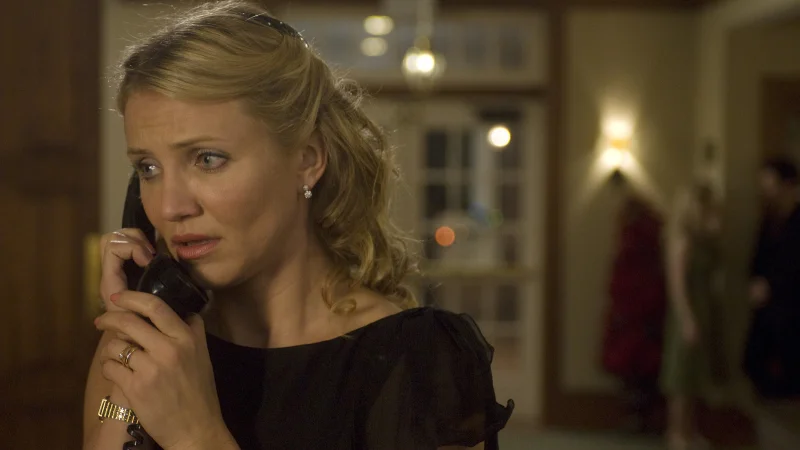
Richard Kelly's last film to date, The Box, turned Richard Matheson's Button, Button into a glossy sci-fi mystery for Cameron Diaz and James Marsden. The 2009 movie took a story that had already lived once on television and pushed it into a bigger, pricier frame, with the central money offer lifted all the way to $1 million.
That change helps explain why people still search for Cameron Diaz and the film now: The Box was never an original premise, but a late stop in a long adaptation chain that began when Matheson's short story appeared in Playboy in 1970. By the time the movie arrived, the story had already been used in the 1986 revival of The Twilight Zone, in Season 1's 20th episode, Profile in Silver/Button, Button.

The numbers inside those versions tell the story cleanly. Matheson's original setup offered $50,000. The television version raised it to $200,000. The film went further still, making the choice feel larger and more fatal by turning it into $1 million. Richard Matheson reportedly hated the small-screen adaptation, even though it landed as one of the anthology's top-rated episodes in that debut season.
The Box then carried the same material into a very different result. It cost $30 million and finished with $33 million worldwide, a narrow return that did not match the scale of the gamble. Most critics and the majority of viewers hated it, and the contrast was especially sharp for Kelly, whose Southland Tales had already fallen far short of its own budget, taking in only $374 thousand against $17 million.
The cast around Diaz and Marsden included Frank Langella, James Rebhorn, Holmes Osborne and Gillian Jacobs, but the familiar faces did not change the verdict. Kelly's version did not replace the earlier one so much as underline it, and the clearest answer is the simplest: the story worked best when its choice felt intimate, not inflated into a $1 million dilemma.
