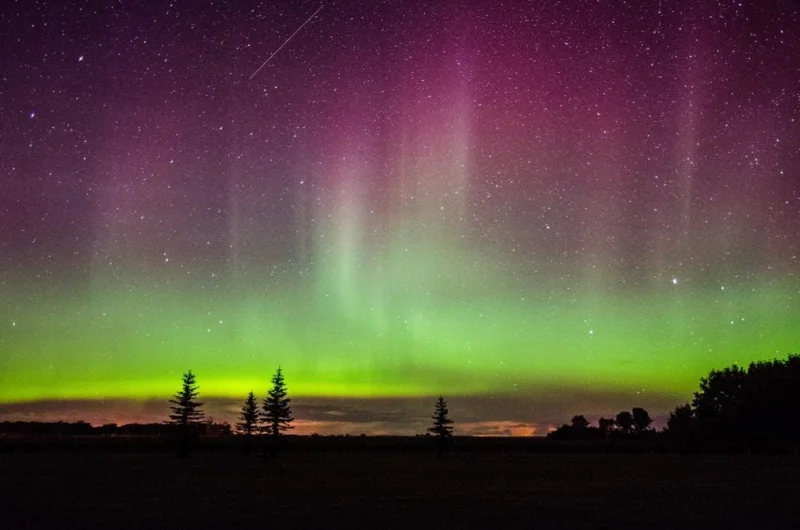
A coronal mass ejection that left the sun on June 26 is expected to reach Earth and could set off a G1 or G2 geomagnetic storm Monday night into Tuesday morning, opening the door to a northern lights display across parts of 19 U.S. states.
The best viewing potential sits in the northern tier near the Canadian border, where people in Montana, North Dakota, Minnesota, Wisconsin, Michigan, Maine, Washington, Idaho, South Dakota and nearby areas have the strongest chance of seeing the aurora if skies stay clear and they look north. NASA and NOAA both use storm strength and timing to gauge how far the lights may spread, and a G1 or G2 event is not the kind of major outbreak that pushes bright aurora deep into the U.S.; that is more the territory of stronger activity, such as KP 4 or KP5 conditions.

The timing matters because the forecast is tied to a specific solar eruption, not a broad seasonal expectation. NOAA expects enhanced conditions early to mid on June 30 because of the June 26 CME, while the UK Met Office sees activity rising to Active to G1 Minor Storms with a chance of G2 Moderate Storms on day 3, with some risk carrying into day 4, July 1.
That does not make the show easy to catch. Long daylight hours after the solstice and the full Strawberry Moon rising Monday can wash out faint color, and even where the aurora is present, cameras often pick it up before the human eye does. Aurora may still be glimpsed farther south in Oregon, Wyoming, Nebraska, Iowa, Illinois, Indiana, Ohio, New York, Vermont and New Hampshire, but those states are more likely to get a faint trace than the best view.
The practical next step is simple: watch NOAA’s 30-minute aurora forecast and live alerts from apps such as Aurora Now, My Aurora Forecast and Glendale Aurora. The question is no longer whether the CME can make the trip; it can. The real test is whether the storm arrives strong enough, and dark enough, to turn a wide forecast into a visible sky show.