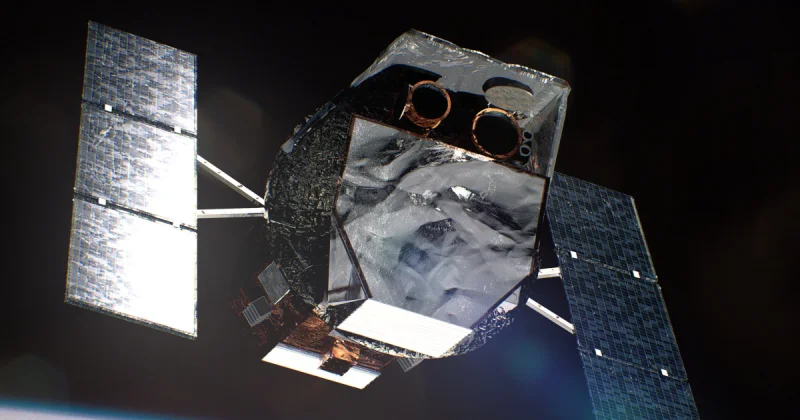
NASA plans to launch a robotic mission on Tuesday to save the Neil Gehrels Swift Observatory, a space telescope that has been circling Earth for more than two decades and is now drifting toward the atmosphere. The plan is to send up a spacecraft that can catch Swift in orbit and push it higher before it falls too far.
The launch is scheduled no earlier than Tuesday at 6:17 a.m. ET, when Northrop Grumman's Stargazer airplane is set to lift off from the Marshall Islands and later release the Pegasus XL rocket at 40,000 feet. That rocket will carry LINK, a 6-foot, 880-pound robotic spacecraft built by Katalyst Space Technologies under a $30 million NASA contract awarded last year.

NASA's models suggest Swift could sink below 185 miles in October, a level that would leave it vulnerable to re-entry and breakup. The observatory studies gamma-ray bursts, and Shawn Domagal-Goldman said NASA wants to save it because of how special it is, calling it a swift observatory that can quickly pivot across the night sky to find things that go boom in the night.
The mission also points to a larger problem that sits behind many spacecraft in low-Earth orbit. Atmospheric drag steadily pulls satellites down, and intense solar activity in 2024 made that drag worse. NASA is trying to rescue Swift even though it was never planned to be serviced in orbit, which makes the capture attempt far more ambitious than a routine boost.
If LINK succeeds, it will do more than raise one telescope. John Nousek said the mission would return a $300 million satellite to full capability for only $30 million, and Kieran Wilson said it could change how astronomers think about satellite lifespans. For NASA, the real test starts after launch: whether LINK can latch on and hold Swift long enough to give the observatory a few more years in space.