


This year marks 100 years of Route 66, and the old highway is being looked at again with fresh eyes. The renewed attention falls hard on the Texas Panhandle, where the road still runs for 178 miles through small towns, worn landmarks and the long shadow of the interstate that replaced it.
That is why Michael Wallis matters in this moment. His book Route 66: The Mother Road, released in the 1990s, helped push the road back into the national imagination and later influenced Pixar Animation Studios’ Cars. For a highway once known as the Main Street of America, that kind of afterlife has become part of the story as much as the pavement itself.

Route 66 was never just a strip of asphalt. It connected the heartland to the West Coast across eight states, and its meaning kept changing with the country around it. John Steinbeck gave it the name Mother Road in The Grapes of Wrath in 1939, when it served as an escape route for his refugees from dust. During the war years, travel by car was a luxury because of rationing. In the fifties, Bobby Troup wrote (Get Your Kicks On) Route 66, and Nat King Cole made it a household name. Jack Kerouac and his Beat buddies took their own trips on the road before On the Road arrived in 1957. By the sixties, the television show Route 66 had made the highway part of pop culture, and Easy Rider closed out that decade’s fascination with the open road.
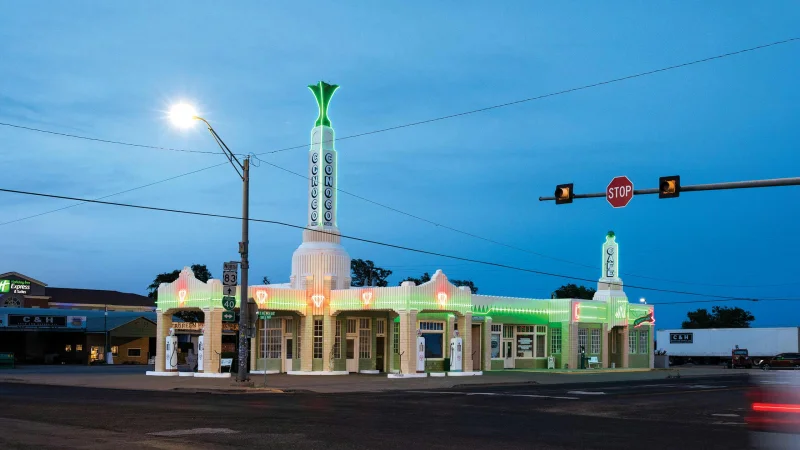
But the romance sits beside decay, especially in Texas. The Panhandle section is dotted with dilapidated relics and small towns that were bypassed when more efficient multilane interstates took over, with Interstate 40 replacing Route 66 in Texas. A restored Conoco gas station in Shamrock and a 1930 Magnolia gas station on South Grand Avenue, now on the National Register of Historic Places, show how much survives only because someone decided it should. Even Texola, once informally known as Beerola, has only about fifty or so residents, a one-room jail that predates Route 66, and a state-line sign beyond town that tourists have covered with stickers.
The centennial does not resolve that contradiction. It sharpens it. Route 66 is celebrated because it still carries memory, but in the Texas Panhandle that memory is uneven, patched together from preserved stops, faded motels and the chance that a traveler in a rented Volkswagen Jetta will slow down long enough to notice what the interstate left behind.
