


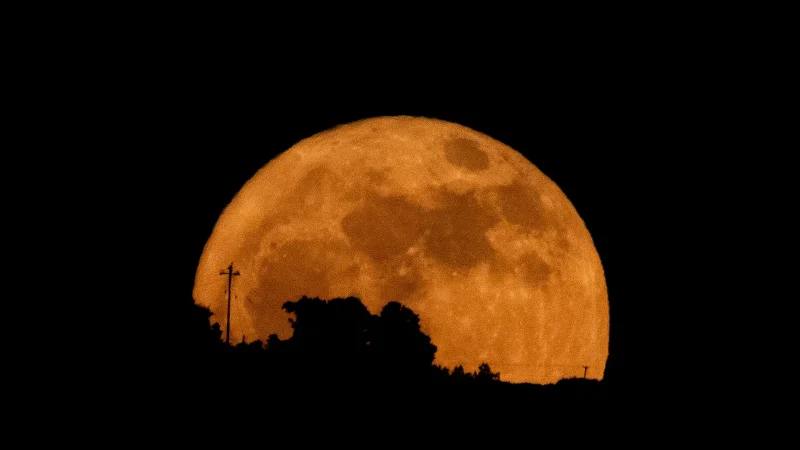
June's Strawberry Moon Full Moon is drawing eyes because it rises and sets at extreme points, tracing an unusually low path across the Northern Hemisphere sky. Instead of climbing high overhead, it appears at an extreme southeasterly point on the horizon, then moves slowly and stays close to the horizon as it drifts sideways through the southern sky.
People in the Northern Hemisphere are searching for it now because the moon is doing something easy to notice even without special equipment. The full moon always sits opposite the sun in the sky, and in June the sun takes its highest and northernmost path of the year in the Northern Hemisphere, so the Strawberry Moon follows the lowest and most southerly path possible.
That is why June's Strawberry Moon can look as if it is reluctant to leave the horizon. It rises late, well south of due east, and its shallow arc makes it linger low in view rather than sweeping quickly upward. For skywatchers with clear southeastern and southern sightlines, the effect is a moon that seems to skim the edge of the world before sliding across the southern sky.

The pattern is not new, even if it looks striking when it happens. The moon does not repeat the same apparent path through the sky every month because its orbit is tilted about five degrees relative to the ecliptic, and the cycle that combines those tilts repeats every 18.6 years. That means the moon's rising and setting positions shift over time, pushing some June moons farther south than others.
Last year's Strawberry Moon reached its most southerly moonrise point since 2006, and another stretch quite like that major lunar standstill will not come again until the 2040s. This year's low path sits in that same long rhythm, which is why the moon can feel both familiar and unusual at once: a recurring June pattern that still makes the horizon look different when it arrives.
What matters for observers is not a precise timestamp but the view. The moon will be easiest to spot where the southeastern and southern sky stay clear, and its path should remain low enough to make the horizon part of the story. For people in the Northern Hemisphere, that is the point of this month's Strawberry Moon: it is not rising high above the night, it is sliding along its lowest road.
