


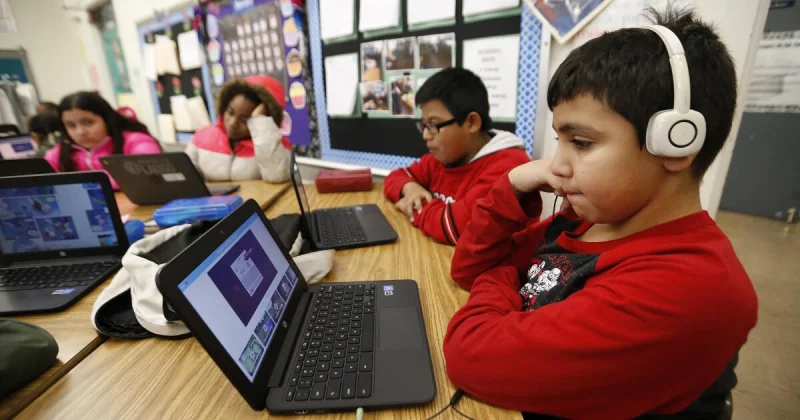
The Los Angeles Unified School District voted Tuesday to cap classroom screen time across every grade, banning it before second grade and setting tighter daily limits for older students. Beginning in August and November, the rules will reach from preschool through high school and end the district’s practice of giving students a school computer to take home every day.
That makes the district’s move immediate and specific, not symbolic. Preschool through first grade will have no in-school screen time beginning in August. Second and third grade will be limited to 20 minutes a day, including homework assignments, beginning in November. Fourth and fifth grade will be limited to 30 minutes. Middle school students will be capped at one hour spread through the week in each class, for a total of six hours weekly. High school students will be limited to 1.5 hours and no more than 10 hours a week.
Nick Melvoin introduced the initial resolution in March, and he said the policy is meant to do more than change one district’s routines. He described it as a document that could become the basis for reform across the country, and even beyond it. That is the scale of ambition attached to a policy that now reaches nearly every classroom device a student in LAUSD might use.

For years, the district had poured effort and money into putting school computers in the hands of every pupil. Now it is moving the other way, answering a backlash from parents and educators who say more time on screens can do harm in early learning. The American Academy of Pediatrics recommends non-digital activities such as play and social interaction for children 5 and under, and experts have linked heavy screen use to language, cognitive and social-emotional delays in young children.
The sharpest question is not whether LAUSD has set the limits, but how it will keep them. The district says it will use software that can track screen time minutes across its devices, which should make compliance visible on paper. What remains less certain is whether that system can measure all use accurately in classrooms where devices are shared, homework is folded into the count, and schedules vary from school to school.
That is why this vote matters beyond one board meeting. Grassroots coalitions have been pressing for screen-time limits in California and nationwide, and some districts have already cut back access to outside websites such as YouTube or moved away from take-home devices. LAUSD has now gone further than most by writing age-based limits into district rules. If the software works and the caps hold, the district will have turned a broad backlash into a concrete model. If it does not, the policy will be remembered as the point where a huge system tried to put the brakes on time spent staring at a screen and found out how hard that is to police in practice.
