


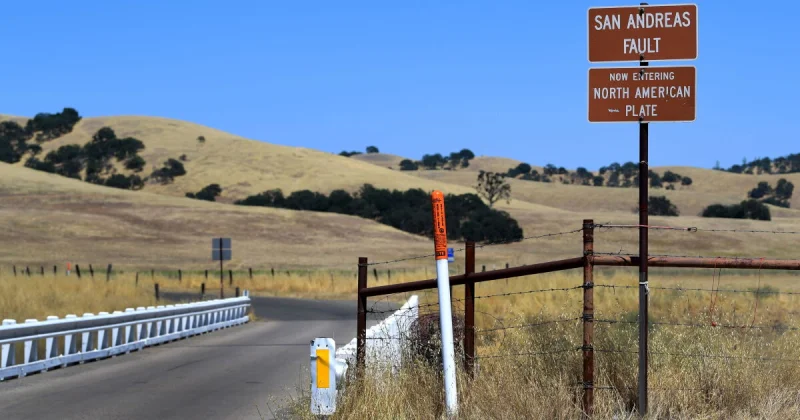
A new study says pressure on Southern California’s San Andreas and San Jacinto faults has climbed higher than at any point in the last 1,000 years, putting the region closer to the kind of major rupture scientists already know will come. The finding matters now because the stress has been building for generations and, in the researchers’ view, the faults are overdue for a large earthquake.
Kate Scharer said the long quiet since the Southern San Andreas or the San Jacinto last produced a large quake has allowed stress to pile up. That is the key reason the search around San Francisco Earthquake risks keeps returning to Southern California today: the question is no longer whether another major event will happen, but how much strain has already been stored in the ground.
The study says the pressure has been rising since the last Big One in 1857, and the researchers did not rely on a single line of evidence. They used geological clues, including tree-ring records and sediment samples, then built a computer model to show how pressure accumulates along faults over time. Harold Tobin said that gives the idea of an imminent future earthquake a more quantitative and rigorous scientific basis.

The results point to a particular danger zone. Cajon Pass could act as an earthquake gate, either stopping or transmitting a large rupture between the San Andreas and San Jacinto faults depending on stress conditions. If a break jumps there from one fault system to another, the rupture could spread farther across Southern California and affect millions more people across the Coachella Valley and San Bernardino County.
That is where the study leaves the cleanest answer and the ugliest uncertainty. Scientists agree Southern California will experience another major earthquake, but no one knows exactly when it will happen, and the paper does not name which segment is most likely to fail first. Liliane Burkhard said the old idea that several fault segments could already have enough stress for a future quake was there before; the new work makes that risk harder to dismiss and suggests the most dangerous break may be the one that links more than one fault at once.
The study also pushes researchers toward other fault systems that behave the same way, where several strands interact and the hazard is hard to predict. Ahmed Elbanna said the reminder is plain: Southern California holds parts of some of the most densely populated regions in the country, and it sits on a multi-strand fault system. For now, the practical lesson is not to wait for a date, but to be ready for the next one with an emergency kit, a communication plan if cell networks fail, and a clear evacuation route.
