


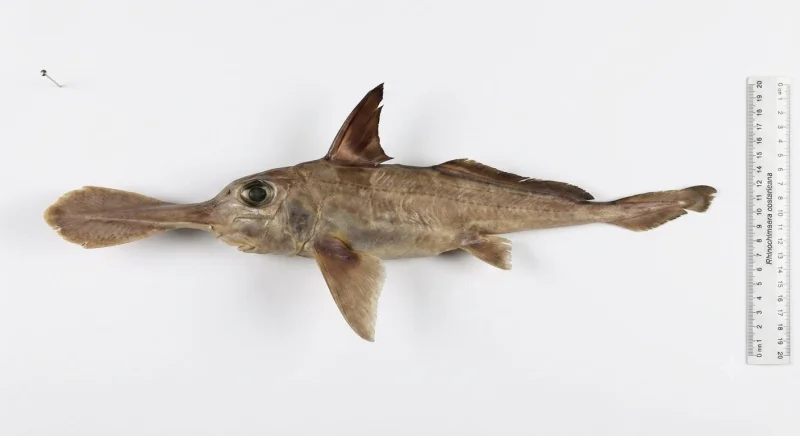
A scientific team has formally described a new deep-sea ghost shark from the Costa Rican Pacific, giving the species the name Rhinochimaera costaricana. The discovery, published June 10 in Zootaxa, turns three long-held specimens into a recognized member of the chimaera family.
The paper was led by Naidely Valeria Vidaurre Quesada, then a Biology student at the University of Costa Rica. Her work links a rare animal to a country that already knew the waters were rich, but not how much they still held unclassified. For readers searching now, the reason is simple: this is not a sighting or a rumor, but a formal scientific description backed by museum material and genetic analysis.
Those three specimens were collected between 2000 and 2023 at depths from 390 to 787 meters. The first was found in 2000 near Isla del Caño, while the other two were recovered in 2023 off Cabo Blanco, Puntarenas. They measured between 775 and 830 millimeters in total length, and biologists from Incopesca originally recovered and protected two of them during fisheries research expeditions before the specimens were transferred to the scientific collections at the UCR Museum of Zoology.

That chain of custody matters because deep-water species are rarely described from fresh catches alone. In this case, the preserved material made it possible to compare shape and structure against the only three other recognized Rhinochimaera species in the world: R. africana, R. atlantica and R. pacifica. The new Costa Rican fish was set apart by a unique combination of morphological traits and genetic evidence, including sequence differences of 3.9% from R. africana, 4.5% from R. atlantica and 4.7% from R. pacifica.
Naidely Valeria Vidaurre Quesada also traveled to the Natural History Museum in London to review historical global archives, with support from the University of Costa Rica and the Deep Ocean Alliance. That extra step helped place the specimens in a broader taxonomic record and strengthen the case that this was not variation within a known species, but a distinct one. The collaboration also brought together the University of Costa Rica, Incopesca and the Federal University of Pará.
The unresolved part is not whether Rhinochimaera costaricana exists; the published description settles that. What remains unknown is how widely it lives in the deep waters off Costa Rica, how it moves, and whether more specimens are already sitting unrecognized in collections or still swimming below the range of routine surveys.
