


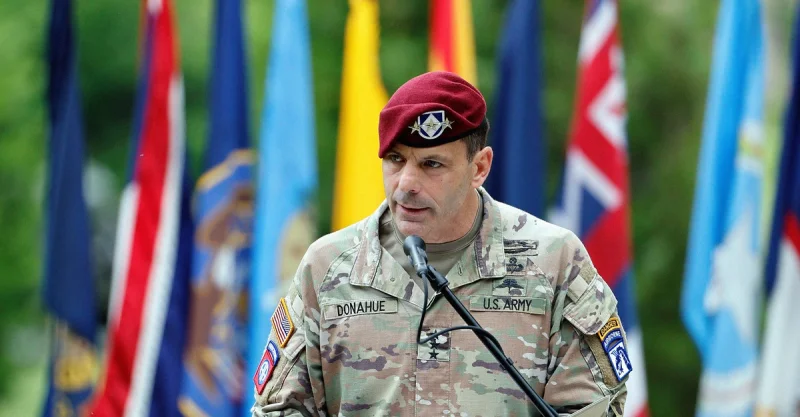
General Chris “C. D.” Donahue is expected to give up his Pentagon post later this summer, ending an 18-month run leading Army forces in Europe and Africa and cutting short one of the Army’s most closely watched careers. He is expected to announce as soon as tomorrow that he will relinquish the job.
The departure matters because Donahue was not a routine staff officer. He was widely seen as one of the Army’s rising stars and had been considered a top candidate for Army chief of staff or even chairman of the Joint Chiefs of Staff. Instead, he is on track to leave a command that has been central to U.S. military planning in Europe and to the effort to absorb lessons from Ukraine.
Donahue’s name still carries the image of Kabul. He was the last U.S. soldier to leave Afghanistan, boarding the final U.S. military plane out of Kabul at 11:59 p.m. on August 30, 2021, in the chaotic end to the 2021 withdrawal. That moment made him one of the most recognizable faces tied to the evacuation, and it helped cement his reputation inside the Army as a combat-tested officer who had served in Iraq, Afghanistan and Syria during two decades of counterterrorism wars.

Now his exit lands in a very different political climate. Pete Hegseth has repeatedly criticized those associated with the Afghanistan withdrawal, is overseeing an investigation and has made clear that he wants fewer top brass in the building, not more. His message, in effect, has been “less generals, more GIs.” General Randy George was forced out this spring, and Donahue would be at least the sixth three- or four-star Army general to depart unexpectedly.
The timing also raises a structural question inside the Army. The military is expected to downgrade U.S. Army Europe and Africa from a four-star command to a three-star post, which would mean Donahue is leaving as the command itself is being reduced in rank. That does not explain whether he is stepping away on his own or being pushed, but it does show why his exit is more than a personnel shuffle: a senior commander who had been helping bolster Ukraine and shape future war planning is leaving just as the Army is reordering the job beneath him.
For Donahue, the significance is hard to miss. He went from the hazy night-vision image of the last plane out of Kabul to a position that once seemed to place him on a direct path to the Army’s highest offices. Instead, he is expected to be gone after 18 months, and the next announcement will tell whether that ends a sudden fall or simply begins another turn in a career that has already been defined by the most consequential exits of the U.S. military’s recent wars.
