


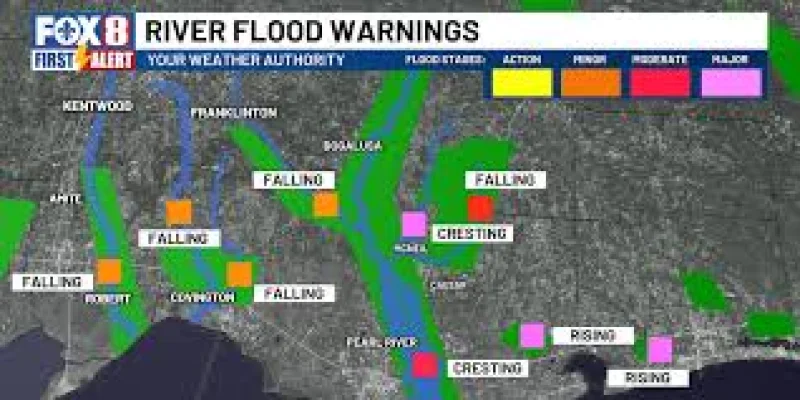
Several rivers across Southeast Louisiana were running high Friday, and the West Hobolochitto Creek near McNeill was already cresting at a major stage at 20.50 feet. The Jourdan River was expected to reach major level, while the Pearl River was cresting at a moderate stage at 16.82 feet.
That mix of readings matters because the region is not moving in one direction at once. The East Hobolochitto Creek near Caesar was falling at a moderate stage at 18.31 feet, the Tchefuncte River near Covington was at 24.44 feet and falling at a minor level, and the Bogue Falaya River at Boston Street was at 9.85 feet and also at a minor stage. In other words, some waterways were still climbing toward higher water while others had begun to ease back.

The Jourdan River stood at 10.78 feet and was forecast to crest at 11 feet, a small rise that still keeps it in the line of elevated readings that can unsettle flood-prone neighborhoods. That is why residents in flood prone areas were told to monitor conditions closely as water levels continued to fluctuate throughout the region, a warning that fits a day when one creek is at major stage and others are only at minor or moderate levels. The river readings show a patchwork flood picture, not a uniform event, which is often harder for people living near the waterways to read by sight alone.
The friction is that the highest water was not spread evenly. The West Hobolochitto Creek was already at a major stage near McNeill, while the Tchefuncte River and Bogue Falaya River were still only at minor stages, and the East Hobolochitto Creek was falling. That contrast points to changing local conditions along each waterway rather than one broad surge across Southeast Louisiana and Mississippi. It also means the same Friday reading can tell very different stories depending on which riverbank a person stands on.
What matters next is not a new headline but the pace of the water itself. With several rivers cresting, one expected to reach major level and others still falling, the region remains in a shifting state that can change block by block. For people in low-lying areas, the practical question is whether the elevated readings hold long enough to spill over into roads, yards or homes before they start to drop.
