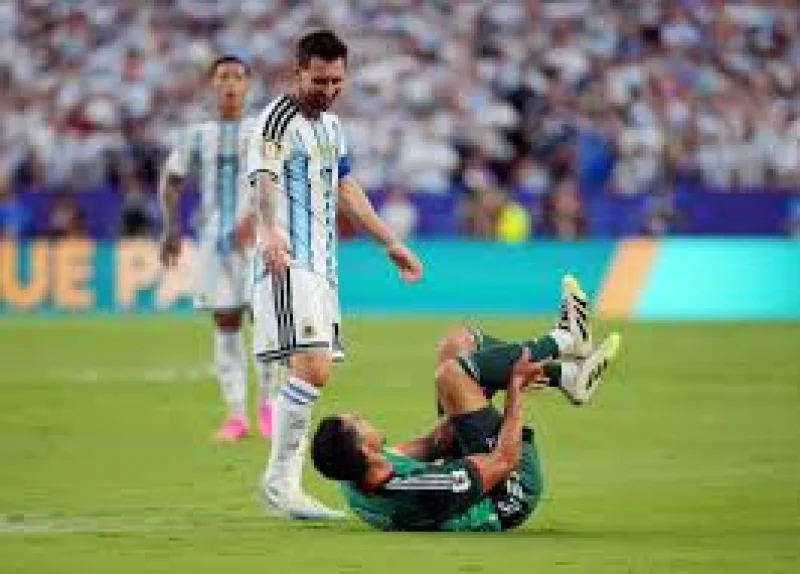
Lionel Messi escaped a red card in soccer debate on Tuesday after a heavy challenge on Aissa Mandi was punished only with a free kick. The referee, Szymon Marciniak, saw enough in real time to let Messi stay on the field.
That decision matters because Marciniak is not just any official. He was in charge of the 2022 World Cup final, and his call in a match carrying World Cup stakes instantly became part of the wider argument over how much latitude star players receive when the game is tight and the contact is ugly.
Messi’s tackle was clumsy enough to draw immediate scrutiny, and on replay his studs were planted into Mandi’s calf. The Algerian defender was hurt, but he did not require treatment, and the Algerian players showed no sign that they believed there was malice in the challenge. That matters, because a straight red card for serious foul play is not handed out for every painful collision. The standard is higher: there has to be evidence that the player endangered an opponent’s safety or used excessive force.
On that reading, few referees would have dismissed Messi. There was no clear intent in the action, and the force, while careless, did not look like the kind that routinely crosses the line into dismissal. Marciniak would have had to judge in the moment whether the tackle was merely reckless or serious enough to justify a sending-off. In real time, the answer was no.
The harder question is what might have happened with more time and a slower look. The article says Messi was fortunate because the referee may have reached for a red card if shown slow-motion replays on the pitch-side monitor. That is where VAR can cut both ways. It can preserve the on-field call when the footage supports it, or it can magnify a moment until a foul that looked messy at full speed starts to look like a dismissal. Here, the original decision stood, and the game moved on.
That is why the incident will linger beyond Tuesday. Superstar players do get some preferential treatment from referees, though not nearly as much as fans sometimes believe, and every touch involving a player like Messi is magnified. The line between a hard foul and a red card in soccer is supposed to be clear. In practice, it often depends on how quickly the referee sees it, how much force he thinks was used, and whether the video shows enough to overturn the first reaction. In this case, Marciniak’s first reaction was enough to spare Messi, and that is likely where the debate will stay unless any further disciplinary action follows.