


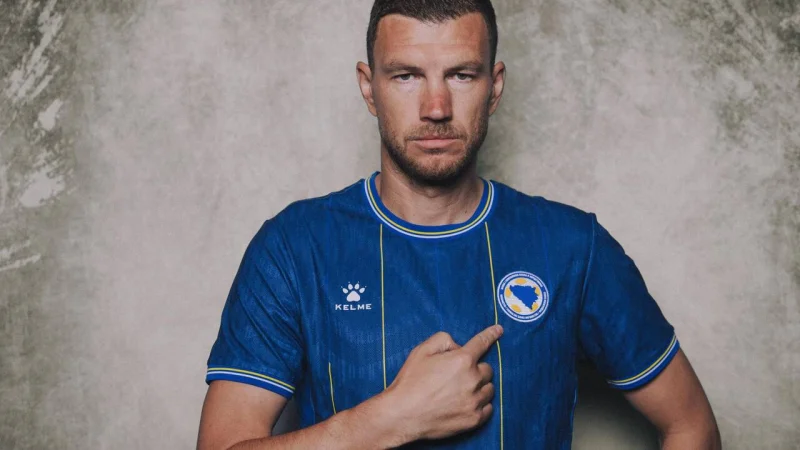
Edin Džeko is heading into the Coupe du monde 2026 as Bosnia and Herzegovina’s enduring face, still carrying a team shirt at 40 and still carrying the weight of a country that made him into a symbol. With 148 selections behind him and a career that has stretched across 867 matches at major European clubs, he is being cast once again as the player who explains Bosnia to itself.
That is why his name keeps surfacing now. Džeko’s story is no longer only about goals for Manchester City, AS Rome or Inter de Milan. It is about what he has come to mean to people who grew up with war, flight and separation, and to those who know him only through the shirt he has worn for years. In a letter on The Players’Tribune, he said he considers himself lucky. For Bosnians, luck is only part of it. He is also a reminder that one of their own can stay tied to home after becoming a star abroad.
The scale of that attachment shows up in the way people talk about him. Asmir Selimovic called him an idole nationale, saying that when he scores, refugees from Bosnia around the world score with him too, and that he is their model and their hope. Safet Alic said Džeko’s number 11 is sold on the pijaca in Bosnia, where people have long worn his shirt. Those lines matter because they describe more than admiration; they describe a player turned into a common language for a country split by the war of the 1990s and scattered across borders.
That history also explains the friction around his legend. A forward who spent his best years at top clubs in Europe could have drifted away from the place that shaped him. Instead, Džeko has remained close enough to Bosnia and Herzegovina to be read as a national bridge, not just a former scorer. The article places him in Germany with Schalke 04 after its promotion in Bundesliga, but the larger point is that the move is still framed through Bosnia first, football second.
What comes next is still the open part of the story: how Bosnia and Herzegovina will use a 40-year-old icon at the Coupe du monde 2026, and whether Džeko can keep turning memory, exile and pride into something useful on the field. For now, he remains the player Bosnians look to when they want proof that distance has not broken belonging.
