


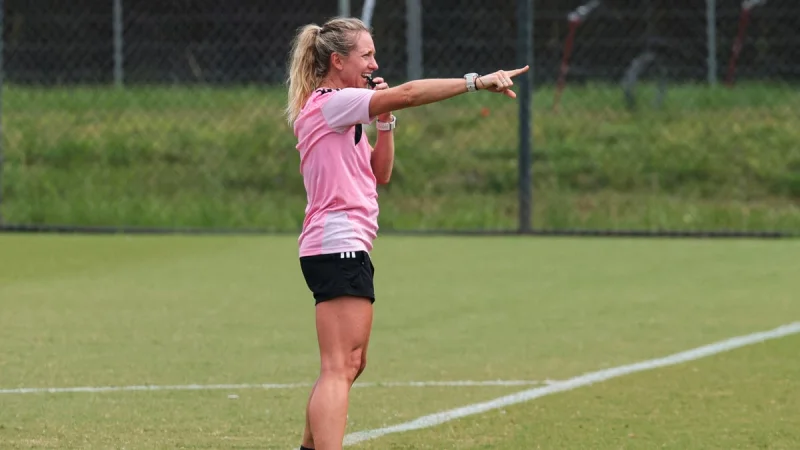
Tori Penso, Brooke Mayo and Kathryn Nesbitt were assigned to the South Africa-Czechia match on Thursday, June 18, and in doing so became the first all-female officiating crew from the United States to work a men’s World Cup match. It was also only the second all-female crew in tournament history to handle a match at the men’s World Cup.
The assignment lands now because this year’s tournament has six women referees, matching the total from Qatar four years ago, but with a different mix and a new milestone attached to it. Kathryn Nesbitt is the only holdover from that tournament, while Penso and Mayo joined a group that has slowly expanded since women first worked men’s World Cup games four years ago.
That earlier breakthrough came when Stephanie Frappart became the first woman to referee a men’s World Cup match in Poland-Mexico and later led the first all-women officiating crew for Germany-Costa Rica. The South Africa-Czechia assignment does not eclipse that moment so much as it extends it, this time with an all-U.S. crew in the spotlight and three officials taking distinct roles in the same match: Penso as referee, Mayo as one assistant and Nesbitt as the other.
Kari Seitz, who began refereeing when she was 14 and later worked nine World Cup matches and six Olympic matches, sees the assignment as proof of a door that is opening, even if not fast enough. She said it has been her life’s mission to show women can do anything and that her job is to open the door so they can run through it, but she also said more women should be here and that the fight is still on. Women make up around 22% of referees in the United States, a share that sits below the roughly 30% figure cited for each country more broadly.
That gap matters because elite officiating is still a grind of nonstop running, pressure and criticism, and the path to the top remains narrow even after the sport’s biggest stage has started to change. Seitz, who was inducted into the National Soccer Hall of Fame last month, said the numbers are growing but not by a large enough percent, and that people will only stop caring about gender when they care only about the quality of the work on the field. For Penso, Mayo and Nesbitt, Thursday’s match is a milestone; the next question is how many more of these crews FIFA and U.S. Soccer will send out before this stops feeling historic.
