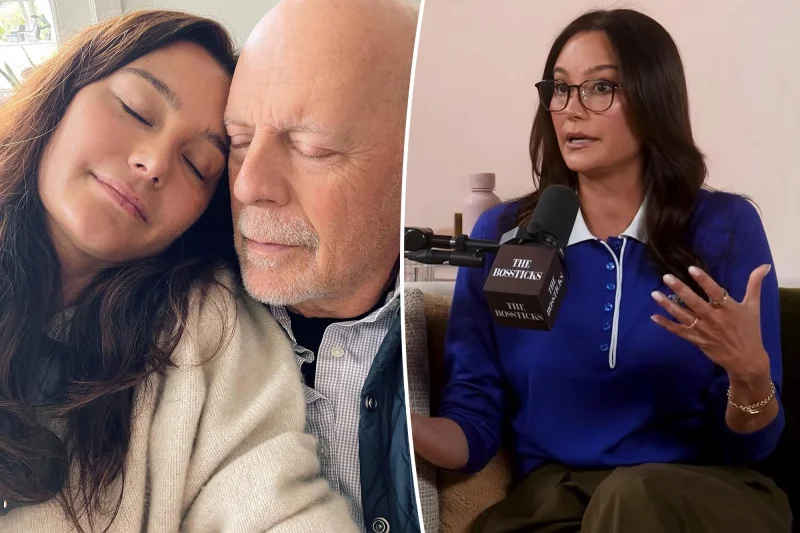
Emma Heming Willis says she thought she had to carry Bruce Willis’s care on her own, and that doing so made her feel like a failure because she needed help. She made the remarks while talking about the burden of caregiving after the actor was diagnosed with aphasia and frontotemporal dementia nearly four years ago.
The interview lands as she is promoting The Unexpected Journey, the book she published in September as a guide to caring for the caregiver. More than a dozen editions are already out in different languages, and Heming Willis said the response shows how wide the problem is. “I think it shows that this is a universal problem,” she said, adding that there are many caregivers without any roadmap.
Heming Willis said she was up at four in the morning on the day she spoke with EL PAÍS from Los Angeles, where she described a daily reality that still looks much larger than one family. She has cared for Bruce Willis for more than 17 years, and she said the book is meant not just for people dealing with dementia, but for anyone looking after a dependent person. The aim, she said, is simple: give caregivers something she did not feel she had when the diagnosis came.

That diagnosis arrived in a neurologist’s office nearly four years ago, when she was handed a piece of paper and told that Bruce Willis had aphasia and frontotemporal dementia. Heming Willis said the moment was especially hard because the condition was described as incurable and irreversible, yet she still had to walk out and figure out what came next for her husband, their two daughters, Mabel and Evelyn, and the rest of their family. Mabel is 14 and Evelyn is 12.
The friction in her account is plain. Heming Willis said she is a young, healthy woman in a stable family with access to support, financial resources, education and good connections, and still felt unsupported. “I know I’m in a privileged position because I have access, I have resources that many people don’t have,” she said. “I thought I had to take it all on myself and that I was a failure because I needed support.”
That is what makes her book more than a memoir about Bruce Willis. It is an attempt to name the loneliness that can follow a diagnosis and the silence that can greet families when they leave medical appointments with no guide in hand. Heming Willis said caregivers often walk out with nothing and are asked to do too much. Her book now sits in more than a dozen languages because that complaint is not local, and because the gap she is describing remains open.