


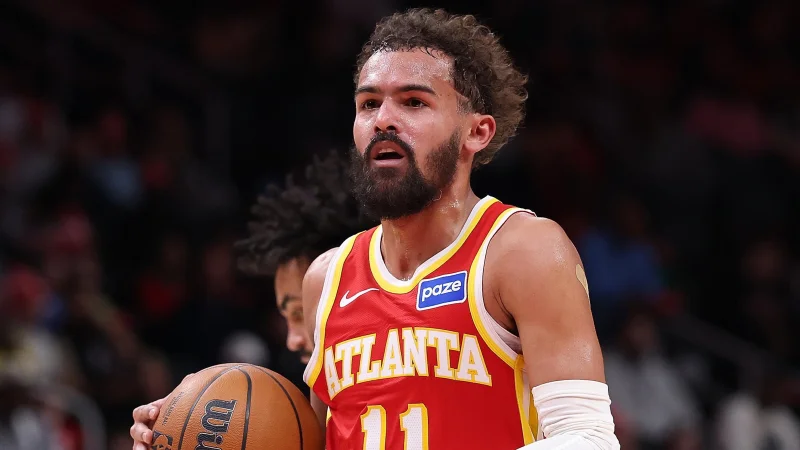
Washington wants Trae Young to turn down his $49 million player option and settle for a longer extension at a lower annual rate, a clear sign the team would rather lock him in on its own terms than let the contract sit at its current peak. The timing is tight, because draft day next Tuesday is the point by which his decision starts to carry the sharpest trade signals.
That urgency helps explain why Trae Young is being watched so closely now. Teams are already eyeing him as a possible trade target, and the changed lottery rules have made a floor-raiser like Young more valuable than he used to be. In that setting, a player who can keep a team afloat carries real appeal, especially to clubs trying to avoid a long reset.
Washington’s logic is straightforward: a lower per-year number on a longer deal would give it more certainty and more room than the $49 million option. It also reflects a market that is not as loose as it looks from the outside. Young drew virtually no meaningful interest at the trade deadline, which is part of why the current push is about structure as much as talent. The Miami Heat, for example, view him as a big fish backup if they miss on Giannis Antetokounmpo.
The sticking point is that the player option itself still matters. If Young picks it up by draft day next Tuesday, it would be read around the league as a sign he is about to be traded, not that Washington has won its preferred outcome. That is the friction in the middle of all this: the team wants commitment, but the option gives Young leverage and leaves the door open to a very different path.
What happens next is simple enough. Young has to decide by next Tuesday whether to take the $49 million or keep negotiations moving toward a longer deal. If he chooses the option, the league will treat that as a signal that something bigger is already in motion.
Walker Kessler is living through a similar kind of uncertainty elsewhere, and it helps show how quickly offseason leverage can change. Once the Jazz extend a $7.1 million qualifying offer, he becomes a restricted free agent, and the Jazz can match any offer sheet. Kessler is frustrated by the way the Jazz are handling that process, he was already upset that they did not offer him an extension last summer, and he is strongly considering a basketball future outside Utah. He can work out a deal with the Jazz, sign an offer sheet with another team starting on July 1, find a sign-and-trade route, or take the $14.6 million qualifying offer as a path to unrestricted free agency next summer. Sam Amick has reported that Kessler is currently disenchanted with the Jazz franchise, and the Lakers are among the teams with cap space that could make him an offer. Peyton Watson is also a restricted free agent, and his absence during the playoffs was part of the broader backdrop to this offseason scramble.
