


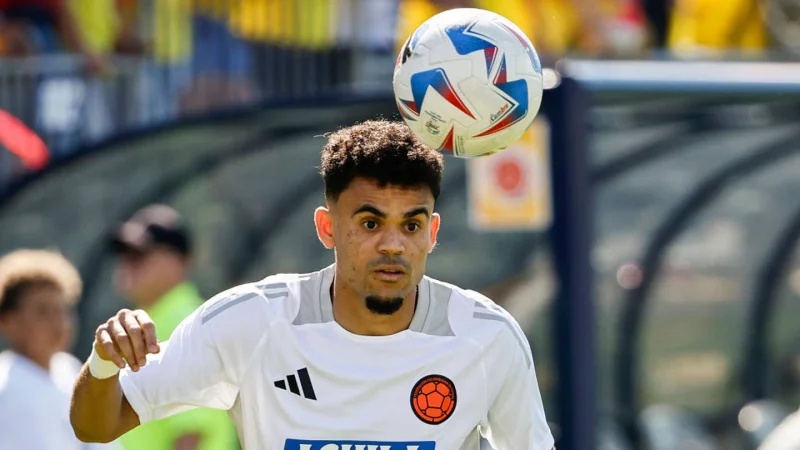
For Luis Díaz, the leap from Barrancas in La Guajira to Bayern Múnich was not built in a straight line. It began on dirt and sand fields, with no elite facilities or bright lights, and it ended in one of football’s biggest stages.
That is why his name keeps returning to searches in Colombia today. Díaz, 29, came out of a municipality of a little more than 40,000 people near the border with Venezuela, a place better known in national news for drought, child malnutrition, lack of water and Indigenous communities left behind than for producing stars. Yet he became one of the country’s most visible players, and his story still carries the weight of where he came from.
His first football steps came under the direction of Luis Manuel Díaz, who ran a small local school where the future forward began his relationship with the ball. As a child wayúu, he chased it through Barrancas and developed speed, dribbling and aggression in the rough conditions around him. By 2015, he was already being noticed at the Copa América de Pueblos Indígenas while representing Colombia, and Carlos Valderrama saw enough to push him forward. Valderrama later summed it up bluntly: young players show what they are made of early, and that boy, he said, was going to go ahead.
The recommendation led Díaz to Barranquilla FC, a Junior affiliate that gave him a special program of alimentation and physical strengthening. That mattered because it changed the frame of his development: he was no longer relying only on raw pace and instinct, but on a process that helped shape his body for higher-level football. From there he debuted with Junior, won titles in Colombia, moved to Europe with Porto in 2019 and later played for Liverpool in the Premier League and Champions League before joining Bayern Múnich.
But the story never stayed only on the pitch. In October 2023, his parents were kidnapped in Barrancas. His mother was freed a few hours later, while his father remained captive for almost two weeks. The Colombian government intervened, and the Ejército de Liberación Nacional was blamed. Days later, Díaz scored for Liverpool against Luton Town and lifted his shirt to show a message that said “Libertad para papá.”
That was the point where a football rise became something larger. Díaz was no longer just the boy from Barrancas who made it to Europe; he had become a symbol of how Colombian talent can come from places the country often overlooks, and of how quickly a private family crisis can turn an athlete into a national figure. What remains unresolved is not where his career can go next, but how long a player can carry both the burden of public success and the memory of a family kidnapping that pulled him back home.
