


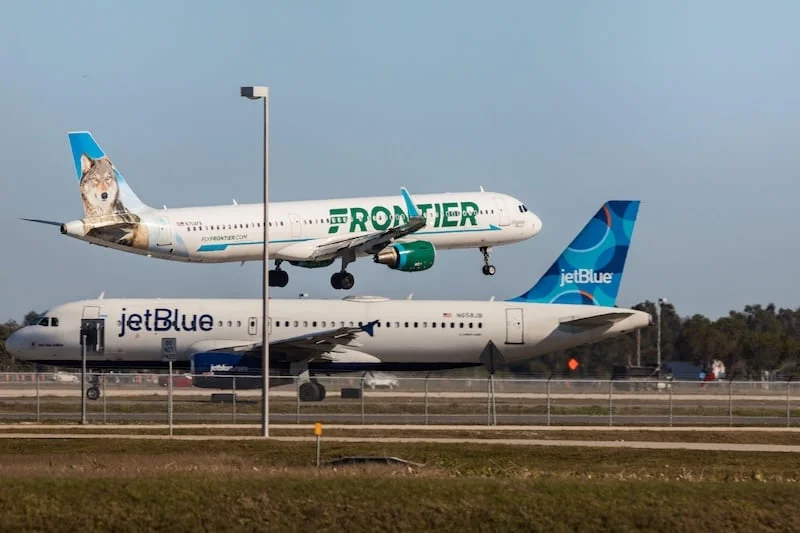
Frontier Airlines and JetBlue Airways are emerging as the biggest winners from Spirit Airlines’ collapse, adding most of the seats now being put back into the former Spirit network after the carrier grounded its fleet and began winding down operations on May 2.
Competitors have added about 2.7 million seats across 339 routes Spirit served in summer 2025 for the June-August 2026 period, but that still replaces only about 48% of the 5.67 million seats Spirit operated in those markets a year earlier. Overall capacity across the former Spirit network remains down 8.8%, a sign that the market has filled in quickly in some places and barely at all in others.
Frontier has expanded the most. Its capacity across former Spirit markets has risen by about 1.3 million seats, a gain of roughly 70%, and its share of available seats in those markets has climbed from 5.6% to 10.4%. JetBlue’s push is also sizeable. The airline added 11 new Fort Lauderdale destinations on the day Spirit shut down and plans to run nearly 130 daily departures from Fort Lauderdale this summer, with growth showing up most clearly on routes to Atlanta, Austin, Dallas-Fort Worth, Houston Intercontinental, Baltimore and New Orleans.
That leaves a gap that is still visible in the numbers. JetBlue has added more than 500,000 seats on former Spirit routes between the June-August periods in 2025 and 2026, while Breeze Airways added about 134,000, United Airlines roughly 334,000, American Airlines about 299,000 and Southwest Airlines about 130,000. Delta Air Lines is broadly unchanged. The additions are real, but they do not come close to restoring what disappeared when Spirit reentered Chapter 11 in August 2025 and then shut down after failing to secure rescue financing.
Fort Lauderdale remains one of the hardest-hit airports in the breakup. Capacity there across the routes Spirit operated during peak summer 2025 is still about 268,000 seats below June-August 2025 levels, and more than 20 former Spirit routes have no scheduled service this summer. Spirit helped pioneer the ULCC model in the U.S. by selling low base fares and charging separately for bags and seat assignments, but its collapse ended a 33-year run and left travelers in former Spirit markets with fewer options than the replacement numbers first suggest. The market has shifted fast; it has not yet healed.
Spirit Airlines shuts down after rescue effort collapses, 444 shakes the budget-carrier market
