


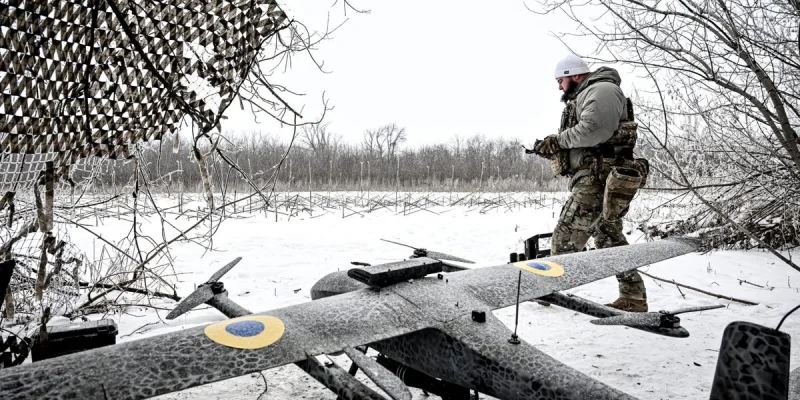
Ukraine’s new mid-range attack drones are pushing farther into Russian rear areas, and one mid-2025 strike hit a house in Zaporizhzhia where Russian FPV drone pilots were living. Spring, a drone pilot with the Ukrainian National Guard’s Typhoon unit, said it was her first successful strike.
The footage reviewed from that attack shows why the drones are getting attention now. They can fly roughly 30 to 300 km, carry heavier explosive payloads than the small drones that have become a daily feature of the war, and some can use artificial intelligence systems to keep going toward a target if the pilot’s signal is lost. That matters because Russia has been using jamming to break the link between drone and operator, but the new systems are built to keep pressure on a target even when contact drops.

The timing helps explain the search interest. Use of the drones has risen in the last two months, and in that same period Russia has been losing more ground than it has gained. George Barros said the Ukrainian mid-range strike is heralding a new phase of the war, while Gil Barndollar said the weapons appear to be having a meaningful impact on Russian logistics in some sectors of the front. That does not mean every gain on the map came from drones alone, but it does suggest they are making it harder for Russia to move supplies, troops and equipment with the same ease.
There is a catch. Russia was able to curb the threat from HIMARS after the first year of the war, even though Ukraine is now trying to recreate that strike effect with drones. Early in the war, Ukraine leaned heavily on Western-made weapons and donor-country targeting support to hit deep behind Russian lines. British-French Storm Shadow missiles and roughly 40 US-made HIMARS launchers gave Kyiv reach it did not have on its own, with the missiles and rockets used against headquarters, rally points, supply depots and other rear targets. The new winged drones are cheaper and more flexible, but they still have to prove they can keep the same pressure on Russian rear areas once the jamming and defenses catch up.
Barros said Ukraine’s mid-range strike is a foundation for blunting Russian advances, and he said he is bullish on the prospect of Kyiv having substantial upper-hand momentum going into the summer. The next question is whether the recent rise in strikes becomes a steady campaign or just another short-lived advantage that Russia learns to absorb.
