


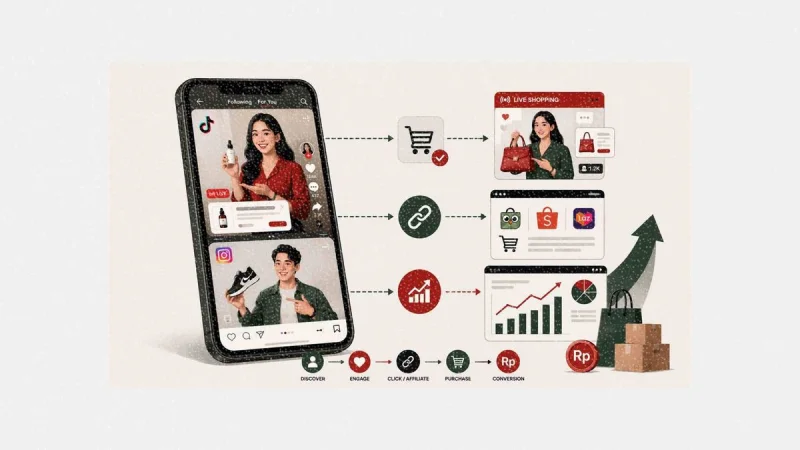
Indonesia’s influencer marketing market has moved further away from awareness-first campaigns and toward measurable results. In 2026, 74% of influencer campaigns in Indonesia are designed with performance outcomes in mind, making the country the clearest example in Asia-Pacific of a creator economy being judged by what it can deliver, not just how widely it can be seen.
That shift matters because Indonesia is not a small test case. It is the fourth most populous country in the world and home to over 1.1 million Instagram influencers, which gives brands a deep pool of creators to choose from and a large audience to convert. For marketers searching the market now, the question is not whether influencer marketing works, but how much of it is being built to produce clicks, purchases and other trackable actions.
The regional data points in the same direction. Across APAC, outcome-driven campaigns rose from 28.24% of total tracked influencer activity in 2023 to 42.47% in 2025. Across Southeast Asia, influencer campaigns on TikTok climbed from 28.35% of total campaign activity in 2023 to 50.58% in 2025, underscoring how quickly performance-first planning is spreading. In Indonesia, TikTok has become the primary channel for product introduction, particularly in consumer goods, beauty and fashion, while TikTok and Instagram both continue to carry weight in the market.

That balance matters because the platforms are being used differently. TikTok is where products are introduced and where discovery tends to happen fastest, while Instagram remains important when the purchase requires more thought, especially for higher-consideration categories beyond beauty. TikTok’s scale helps explain the shift: it had 180 million adult users in late 2025 and reached 88.9% of Indonesian adults who are online, giving creators and brands a direct path to a very large audience.
What makes the market more demanding is that the money is no longer chasing reach alone. TikTok Shop has embedded commerce directly into the creator experience, and live selling sessions, affiliate links in video content and creator storefronts have collapsed the distance between a recommendation and a completed purchase. That is why creator compensation has increasingly shifted toward Cost Per Result frameworks, with campaigns tuned to link clicks, add-to-cart behavior, purchases through TikTok Shop and affiliate conversions.
The risk is straightforward: a market that rewards measurable outcomes can also punish lazy measurement. Brands that do not verify creator metrics can end up paying for inflated follower counts that do not translate into sales or traffic. Experienced buyers in Indonesia now treat that verification as standard practice, which is another sign that the market has matured beyond vanity metrics and into something far more accountable.
The clearest reading of the 2026 data is that Indonesia is ahead of the regional curve. The next step is not whether brands will keep using influencer marketing, but how much of their budget they will keep tied to results they can actually measure.
