


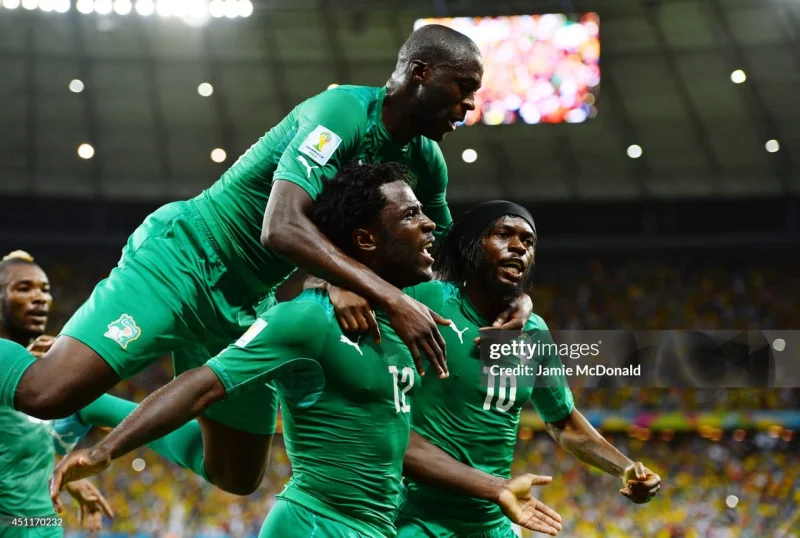
Côte d’Ivoire’s 2014 FIFA World Cup ended on the last touch of a game they were still trying to rescue. Greece beat them 2-1 in the final group match, and Georgios Samaras’ late penalty sent Sabri Lamouchi’s side out at the first hurdle.
That result still matters because the margin was so thin. A draw would have been enough for Côte d’Ivoire to go through, which is why the loss to Greece landed as more than a bad night: it closed the tournament on a team that had opened with a 2-1 win over Japan and then lost to Colombia, only to finish one goal short of progress.
The squad was built around names that carried real weight. Didier Drogba and Yaya Toure were among the world-class players in the side, while Barry spent most of his club career at Lokeren before retiring from playing in 2019 and later moving into coaching as a goalkeeper coach at OH Leuven, Gent U21 and Lokeren-Temse. Bamba played in all three of Côte d’Ivoire’s games in Brazil, and Boka, who had 82 caps, nailed down the left-back role after shining in the previous two World Cups in Germany and South Africa.
That is part of what made the exit sting. Côte d’Ivoire were not undone by inexperience or by a collapse in one match alone, but by the same old problem repeating itself at the biggest stage. The defeat to Greece meant they were eliminated in the group stages for the third successive tournament, turning a generation that had been strong enough to produce back-to-back World Cup appearances into one that never got past the first round.
Some of that generation moved on in different directions after Brazil. One player’s career sparked into life after the tournament, earning a move to PSG from Toulouse and later a switch to Tottenham Hotspur. For the rest, the 2014 campaign became the final World Cup chapter of a group that had promised more than it delivered.
Emerse Faé’s current Côte d’Ivoire side now carries the weight of that history as it looks to break the group-stage curse in North America. The question is not whether the old team had talent. It did. The real measure is how long Côte d’Ivoire can keep this next one alive when the margin for error gets as small as it did in Greece.
