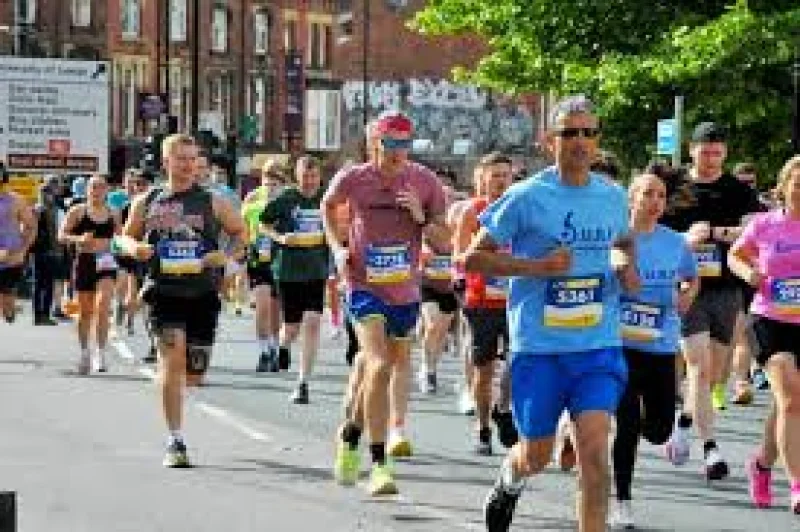
The Leeds 10K starts at 09:00 BST at the University of Leeds and finishes in the city centre, sending thousands of runners onto the streets for one of the city’s biggest fundraising days. For Jasmin Matharu, it is a race tied to her son’s treatment in Chicago, while for Clair Grubb it is a test of endurance against a condition she has lived with for 17 years.
Matharu is hoping to raise £200,000 for hospital care costs at Rush University Medical Centre in Chicago over a two-year programme for her son, who has TUBB4A-related leukodystrophy. She said her world stopped when he was diagnosed at eight months old, and the family will have to relocate for the treatment. The scale of that need gives the Leeds 10K a purpose far beyond the finish line.
The race itself was set up by the Jane Tomlinson Appeal 15 years ago, carrying forward a fundraising legacy that began after Jane Tomlinson died of cancer in 2007 at the age of 43. That history helps explain why the event continues to draw runners with personal reasons as well as charitable ones, turning a city race into a public show of support for causes that would otherwise stay private.
Grubb’s run brings a different kind of weight to the same morning. She has lived with relapsing remitting multiple sclerosis for 17 years and says the condition can leave her tired or bring on a sensation like an electric shock running through her body. Even so, she took up running last year after deciding she wanted to get fitter, and her husband said she refuses to let MS define her.
That is what makes the Leeds 10K more than a start time and a route. It is a single race carrying hundreds of separate motives, from urgent medical bills to the stubborn decision to keep moving despite illness, and by the end of the morning the finish line in the city centre will mark progress for every runner in a different way.