


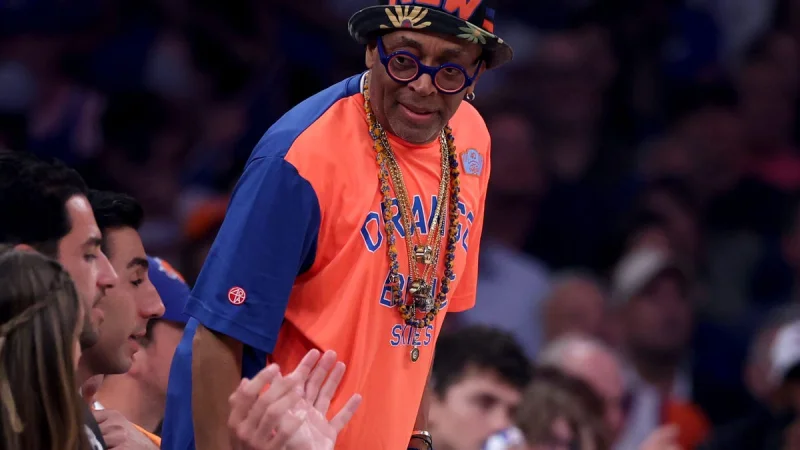
Spike Lee has turned decades of New York Knicks loyalty into a price tag: an estimated close to $10 million spent on tickets over the years. The 68-year-old filmmaker remains a courtside fixture at Madison Square Garden, and his presence has become part of the game-night show.
The question of who is Spike Lee is easy to answer and hard to separate from the arena. He is the fan who flew from the Cannes Film Festival to attend Game 4 of the Eastern Conference Finals, missing only one game because of international obligations, a measure of how far he has gone to stay near the Knicks.
That spending figure is striking because it puts scale on something that has long been visible but never quantified. If tickets alone have approached $10 million, then Lee’s sidelines routine is not a cameo. It is a long-running investment in being seen, heard and occasionally argued with in front of the NBA’s most scrutinized crowd.
Lee’s status in that setting comes from more than money. He broke into the film industry in the 1980s, made his directorial debut with She's Gotta Have It and turned a shoestring production into a box-office success. He later delivered Do the Right Thing, Jungle Fever and Malcolm X, won an Oscar in 2019 for Best Adapted Screenplay for BlacKkKlansman, and built 40 Acres and a Mule Filmworks into a company that has produced over 35 films.
That career has also taken him into NYU's Tisch School of the Arts as a tenured professor, into commercials for major brands and into a deal with Netflix for new projects. His real estate holdings, including a Manhattan townhouse, a Brooklyn production studio and a Martha's Vineyard estate, help explain how a net worth estimated at $60 million can support a habit that most fans could never afford.
Still, Lee’s courtside role has never been simple fandom. His animated reactions and exchanges with rival players have made him beloved to some and controversial to others, which is part of why his seat matters so much. He is not just watching the Knicks; he is part of the atmosphere, and the latest estimate shows just how expensive that front-row identity has become.
What comes next is less about another movie credit than whether Lee keeps turning up in the same seat, at the same games, with the same intensity. The money has already been spent. The real story now is that for Lee, Knicks basketball has become a lifelong expense, and one of the most recognizable purchases in NBA culture.
