


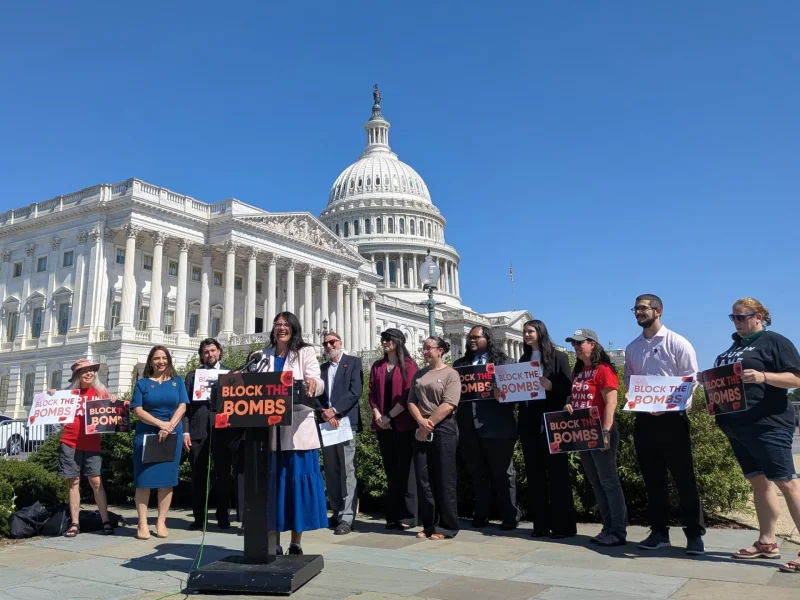
Jack Schlossberg said Tuesday night that he would vote for the Block the Bombs Act, marking a public shift from his earlier uncertainty on a bill that would impose new limits on U.S. weapons sales to Israel. The 33-year-old Democrat said his rejection of offensive weapons was, in his words, a moral question being put to the country right now.
He also said he would support continued U.S. funding for Israel’s Iron Dome missile-defense system, drawing a line between offensive and defensive aid. That position now places him on one side of a raw divide in the Manhattan House race, where voters are choosing a successor to retiring Rep. Jerry Nadler in an open seat that has become a test of how far candidates are willing to go in conditioning military aid to Israel.
Schlossberg’s new answer was notable because it was not the one he gave earlier in the race. In January, he said he was unsure whether he would back the Block the Bombs Act and argued in a questionnaire that the bill would not provide an avenue to peace and stability. He also said then that he would want a full intelligence briefing before supporting any specific legislation on aid to Israel.
That hesitation is what made Tuesday’s declaration stand out. Schlossberg had not publicly backed the measure before the debate, and his rivals did not follow him. State Assemblymembers Micah Lasher and Alex Bores, along with former GOP attorney George Conway, declined to support the bill when asked the same night.
The reversal also sits uneasily beside what Schlossberg has said elsewhere. In May, at a private social club on the Upper East Side, he told members he probably would have continued funding Israel’s offensive weaponry within the years following Oct. 7. Politico obtained audio of that meeting, and his campaign later said his views have evolved as the situation has. Last month, Schlossberg said on social media that he supports no weapons to Israel, before later saying his position has changed as the situation does.
The Block the Bombs Act would impose unprecedented new restrictions on weapons sales or transfers to Israel, and Schlossberg’s shift shows how sharply the issue is cutting through the campaign to replace Nadler. Whether he holds to Tuesday’s line through the final stretch is now the open question, with the June 23 primary set to decide whether his change in position is a one-night answer or the course he carries into the ballot box.
