


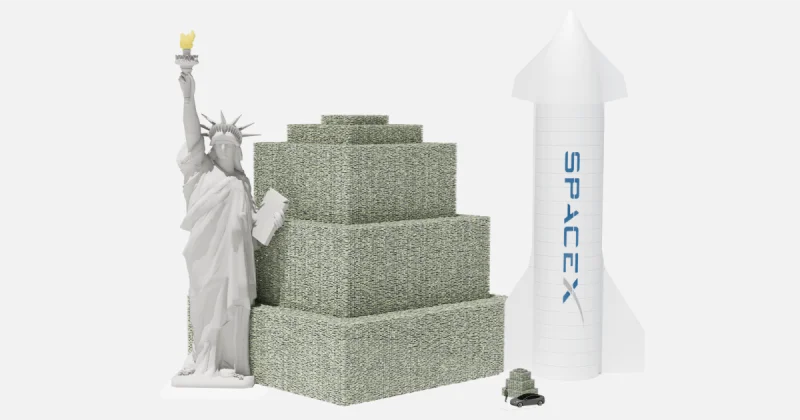
Elon Musk became the world’s first trillionaire on Friday when SpaceX went public, a milestone so large that it instantly rewired the conversation about the richest people in the world. SpaceX’s projected IPO valuation was $1.77 trillion, a figure that helped push Musk into territory no individual had reached before.
The number is easier to say than to picture. A trillion equals 1,000 billion, and John Allen Paulos, who wrote about the limits of human intuition in his 1988 book Innumeracy, has long argued that people struggle to reason clearly about numbers that large. He put it bluntly: “Up until relatively recently, we had no real reason to talk about such numbers,” and “So it’s not surprising that they don’t make much sense to people.”
That difficulty shows up in almost any comparison. A million seconds is less than two weeks. A billion seconds stretches back to 1994. A trillion seconds reaches to roughly 29,000 B.C., which is the kind of time span that makes a modern fortune feel less like cash and more like abstraction. A stack of $100 bills worth $1 million stands just over 3 feet tall; the same stack at $1 billion rises more than half a mile; at $1 trillion, it would climb 679 miles.

The scale of SpaceX’s valuation also lands in familiar business history. Its projected IPO price is nearly 10 times Alibaba’s 2014 valuation, even though Alibaba’s mark still stands as the highest ever recorded in the U.S. OpenAI and Anthropic each hover around $900 billion, far below the SpaceX figure but still in a range that would have sounded fanciful when trillion-dollar references were rare in English-language books for much of the 19th and early 20th centuries, before rising after World War II.
Paulos captured the problem with large numbers years ago by reducing the gap between trillion-dollar sums to a phrase: “A trillion and one.” That is the difference between one impossible amount and a slightly larger impossible amount, and it is why Musk’s new status is less about a balance sheet than about a new mental category. At this scale, even practical comparisons become strange: a trillion dollars could buy 8,880 Boeing 737s or the New York Knicks 102 times over.
For ordinary households, the distance is even starker. A typical U.S. household earning almost $84,000 a year would need nearly 12 million years to accumulate $1 trillion. Spend $1 million a day and the money would still last 2,740 years. Musk’s new title is a market event, but it is also a reminder that the richest people in the world now occupy a financial universe so large that most people can only understand it by shrinking it into years, buildings and miles.
What SpaceX’s public debut ultimately changes is not just Musk’s rank, but the scale at which the market is willing to measure private wealth. The next question is whether trillion-dollar valuations stay a one-off marker of extraordinary companies or become a new floor for the most powerful names in tech.
