


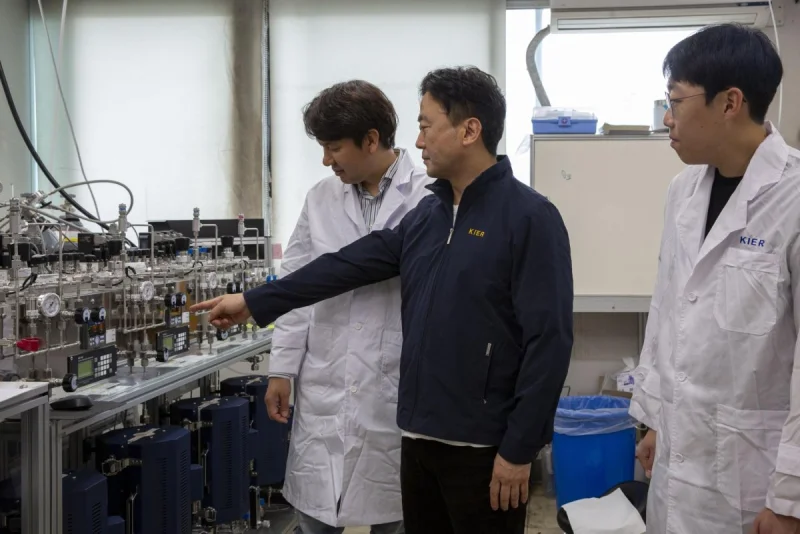
Korea has produced high-purity deuterium ammonia domestically for the first time, and the breakthrough comes with a number that matters to manufacturers: 7.7 kilograms a day, made with a homegrown ruthenium catalyst and verified through more than 1,000 hours of continuous operation. Dr. Yoon Hyung-chul of the Korea Institute of Energy Technology announced the development on the 11th, saying the process had cleared durability and reliability certification from the Korea Institute of Industrial Technology.
The timing is why the work is getting attention now. Korea's semiconductor industry has long depended on imported deuterium ammonia from Japan and China, even as the country has built one of the world's strongest chip-making bases. This material is not a minor input. Ammonia supplies nitrogen to silicon semiconductor devices, and deuterium improves semiconductor quality because it binds more strongly with silicon than ordinary hydrogen does.
What makes the result stand out is not just the purity, which topped 99%, but the process behind it. The team said it improved the pressure and temperature conditions needed for production, moving away from the 500°C and 300-atmosphere demands of the existing ammonia process and showing synthesis at 350°C and 40 atmospheres with a ruthenium catalyst. That shift matters in an industry where every step toward lower energy use and steadier output can change whether a material is viable at scale.
Before this, Korea had no domestic technology or facilities to make deuterium ammonia at all. That gap left a supply chain weakness in a sector that prizes control over materials as much as it does chips themselves. The development does not erase the dependence overnight, but it shows the country has crossed from import reliance into actual production capability, which is a different place entirely.
Yoon said the technology could grow into a small-scale high-function chemical material production platform for semiconductors, displays and precision analysis industries. The researchers now plan to optimize the process and expand production, with an eye on the industrial isotope material market. The next test is not whether the science works — it already has — but how quickly it can be turned into a steady source that chips makers can depend on.
