


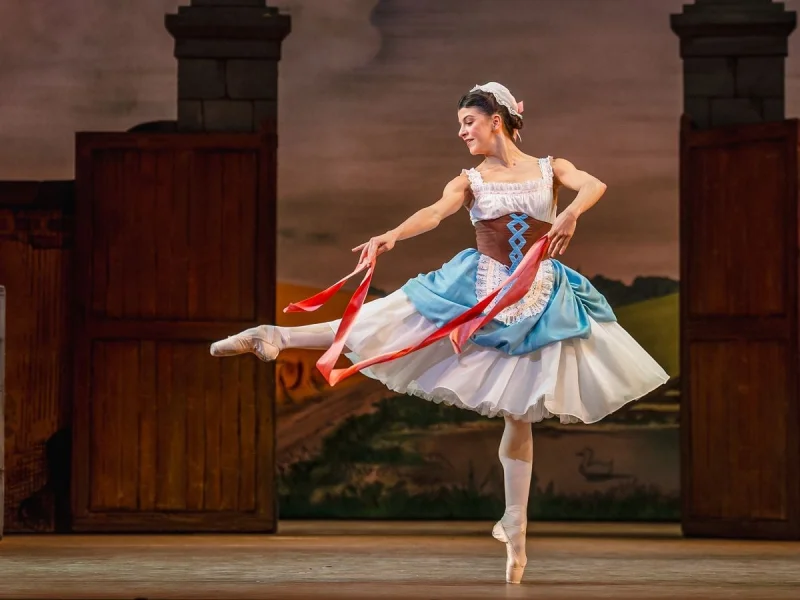
Mayara Magri stepped onstage as Lise for the first time at the Royal Ballet & Opera in London on June 5, 2026, while Leo Dixon made his role debut as Colas in the same performance of The Royal Ballet’s La Fille mal gardée. The evening marked two fresh casting milestones inside one of the company’s most familiar comic ballets.
The timing matters because the performance arrived as audiences were looking for what this long-running favorite looks like in new hands. Thomas Whitehead appeared as Widow Simone and James Hay as Alain, giving the cast a firm comic spine around Magri and Dixon’s debut pairing. For a company whose repertory depends on precision as much as charm, a first night in these roles is more than a routine change of cast; it is the moment a familiar work is re-judged in real time.
La Fille mal gardée still leans on its affectionate portrait of village life, and Sir Frederick Ashton’s ballet remains, in the broadest sense, a love letter to the English countryside. That pastoral ease was part of the appeal on Friday night, though it was not entirely uninterrupted. The new wooden pony that replaced a real pony was a letdown, especially in a production that otherwise depends on texture and warmth to sell its rural world. Even so, the ballet’s two love stories and three children helped keep the evening rooted in the bustling, teasing community the choreography is built to evoke.
The change behind the pony is bigger than one prop choice. Royal Ballet and Opera has decided to retire the use of live animals from all future productions, which means the company’s handling of animal appearances will no longer be case by case. That leaves the question of how later productions, including works such as The Two Pigeons, will be staged without them. For now, Magri’s debut and Dixon’s first outing as Colas gave La Fille mal gardée a fresh center, but the evening also showed how the company’s visual traditions are beginning to shift.
What stood out most was that the production could still feel graceful and generous even as one familiar element changed. Magri and Dixon gave the ballet a new pairing to watch, and the company’s decision on live animals makes clear that future revivals will have to find different ways to preserve that old theatrical charm.
