


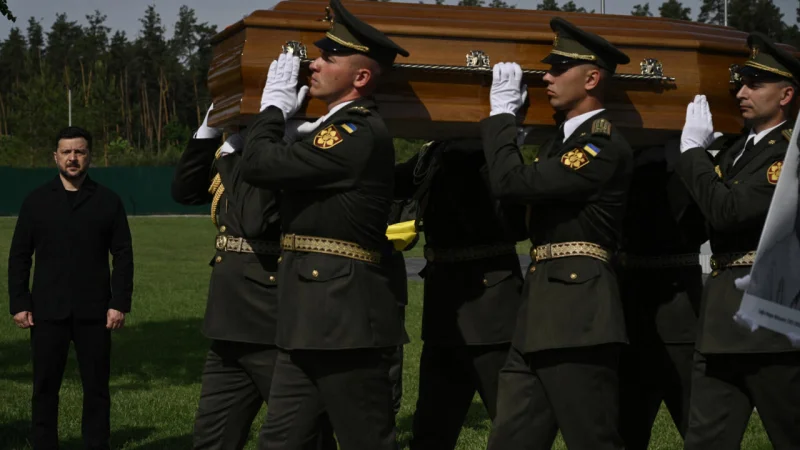
Volodymyr Zelensky signed a decree on May 26 giving an elite Ukrainian special forces unit the honorary title of "Heroes of the Ukrainian Insurgent Army," and the move has set off a new fight with Poland over history and honor. Former Polish president Lech Walesa said he tore a Ukrainian flag badge from his chest when he heard about it.
The reaction was immediate because the Ukrainian Insurgent Army, or UPA, was the armed wing of the far-right Organisation of Ukrainian Nationalists and remains infamous in Poland for massacres of ethnic Poles and Jews in Volhynia and eastern Galicia during World War II. Polish historians say those killings claimed tens of thousands of civilians, and the Polish state treats them as part of a deliberate campaign of genocide.
The timing made the decree harder to ignore. On the day before it was signed, Zelensky presided over the reburial of Andriy Melnyk’s repatriated remains in a national military ceremony near Kyiv. Melnyk died in Germany in 1964 after being buried in Luxembourg, and he had led a branch of the Organisation of Ukrainian Nationalists while backing collaboration between the Ukrainian nationalist movement and Nazi Germany and its fascist allies. He was laid to rest with full state honors alongside Ukrainian soldiers killed during the four-year struggle against the Russian invasion.
For Poland, that sequence turned a commemorative act into a diplomatic wound. Walesa said he would keep supporting Ukraine’s fight against Moscow, but not its president. Former prime minister Leszek Miller called the decree akin to Germany renaming a military unit after the Nazis’ Einsatzgruppen death squads, while conservative President Karol Nawrocki demanded that Zelensky be stripped of the Order of the White Eagle that Andrzej Duda had awarded him in the wake of the Russian onslaught.
Nawrocki also argued that glorifying the UPA had given Russian propaganda plenty of fuel for disinformation, a point that lands awkwardly in a war Moscow already frames as a campaign to "de-Nazify" Ukraine. That is the trap in this dispute: Zelensky is honoring a symbol of Ukrainian nationalist resistance just as Polish leaders see the same symbol as inseparable from the mass killing of their civilians.
The broader quarrel is not new, but the decree has pushed it back into the center of the relationship between Kyiv and Warsaw. A dispute that reaches back at least to Polish independence after World War I has stayed open through the war against Russia, and this latest clash shows how quickly battlefield solidarity can run into the hard edge of competing memory. What happens next now depends on whether Zelensky stands by the decree or decides that the diplomatic cost has become too high.
