


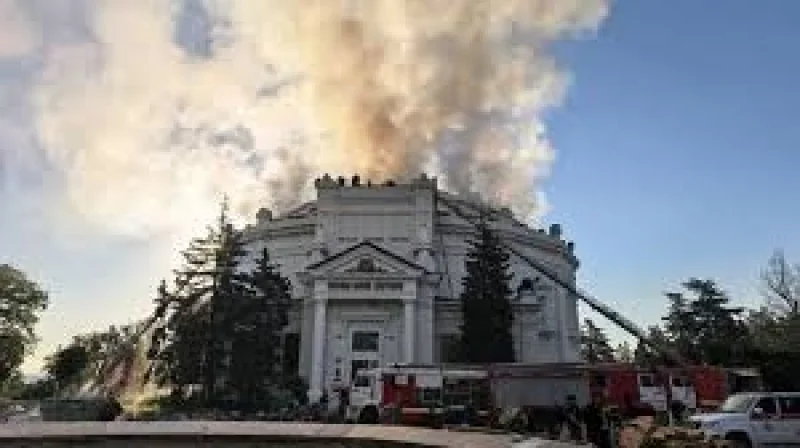
Ukraine hit oil and fuel facilities in occupied Crimea and near Russia’s Black Sea port of Novorossiysk on Sunday night and Monday, setting off fires and adding fresh pressure on supplies in the south. The Kremlin then acknowledged what it had been trying to minimize: Dmitry Peskov said there were “certain problems” with fuel supplies and that measures were being taken.
The shift matters because the damage is no longer limited to the battlefield map. A surge in airstrikes on Russian energy and fuel sites has already disrupted supplies in several southern regions, and one of the hardest-hit hubs is part of the network feeding the Russian military. Ukraine said the Semykolodezkaya oil plant in the Crimean Peninsula caught fire after being struck Sunday night, and that the site stores fuel reserves for the army. It also said an oil depot near Feodosia was hit. On Monday, Ukraine’s military said it struck the Grushovaya oil transshipment base near Novorossiysk in Krasnodar Krai, one of the largest hubs in southern Russia for oil and petroleum products.

Russian regional authorities said a Ukrainian drone sparked a fire at the Grushovaya complex and that up to 130 emergency workers had to be brought in. That response underscores the scale of the disruption even as the Kremlin describes the problem as limited. Peskov’s remarks, delivered after the strikes, did not match the wider picture emerging from the south, where energy and fuel routes have already been strained.
The pressure is landing at the same time Ukraine is taking losses of its own. In the Kharkiv region, regional governor Oleg Synegubov said Russian strikes killed three people in Chuguiv and wounded six people in Kharkiv city. He said, “The enemy has hit the city of Chuguiv,” and added that “three people have been killed as a result of the enemy attack.” Other Russian attacks early Tuesday killed two people in Zaporizhzhia, a 49-year-old woman in Nikopol and a 71-year-old local resident riding a bicycle in Sumy, while a drone strike in Odesa wounded three people at a public transport stop.
For now, the clearest unanswered question is how far the fuel disruption spreads and how long it lasts. The strikes have reached major nodes in Crimea and southern Russia, and the Kremlin has already conceded there are problems. What it has not shown is how quickly those problems can be fixed, or whether the next strike will land on another hub that matters just as much.
