


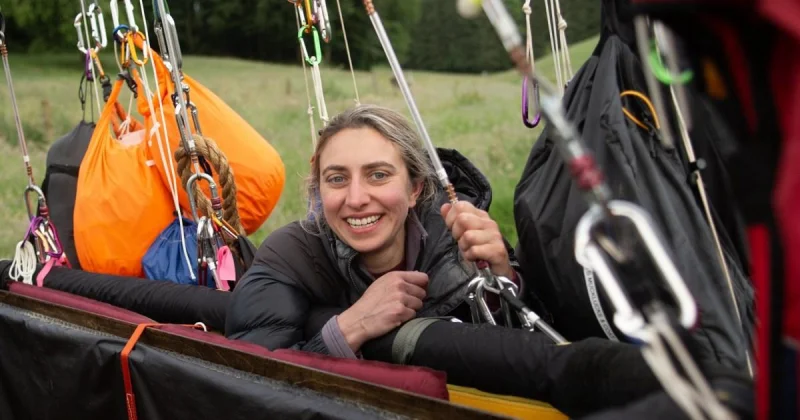
The Atlantic Explorer balloon crew has now committed to crossing the Atlantic Ocean after passing beyond the coast of Nova Scotia, turning a long flight that began before dawn on June 4 into a full transoceanic attempt. Alicia Hempleman-Adams is part of the three-pilot team, and if they make it to Europe she would become the first woman to complete a transoceanic gas balloon crossing.
That is why interest in Hempleman Adams has sharpened today: the balloon is no longer just tracking east in good weather, it has crossed the point where the crew has chosen to press on. As of Friday morning, the craft had covered nearly 900 miles from Presque Isle, was flying at about 12,000 feet above sea level and was moving at speeds approaching 60 miles per hour.
Padelt and Peter Cuneo are flying with Hempleman-Adams on a mission that could last another three to four days, with total flight time stretching to six days depending on wind and weather. The team is attempting a manned transoceanic balloon crossing using hydrogen gas as the sole source of lift, a rare feat in a sport where only 19 successful Atlantic crossings have been recorded in more than 140 years of ballooning history. If they complete the route, the crossing will cover roughly 3,100 to 3,500 miles depending on where they are able to land.
The launch site in Presque Isle carries its own weight in ballooning history. It was also the starting point for the first successful transatlantic balloon crossing in 1978, when Ben Abruzzo, Maxie Anderson and Larry Newman made the journey across the ocean.
But the hardest part is still ahead. Kim Vesely said that once the balloon is past Newfoundland there is no respite until Europe and that the crew’s only place to land is the open ocean, a reminder that the mission has moved from careful positioning to survival and timing. Jason Fischer of Latvia and John Piper of New York are handling balloon inflation, while the flight control team is mainly based in Britain and meteorologists, technical specialists and support staff are spread across the United States and Europe.
If the weather holds, the next three to four days will decide whether Hempleman-Adams and her crew turn a rare milestone into a finished crossing or spend the rest of the trip chasing a narrow window above the Atlantic.
