


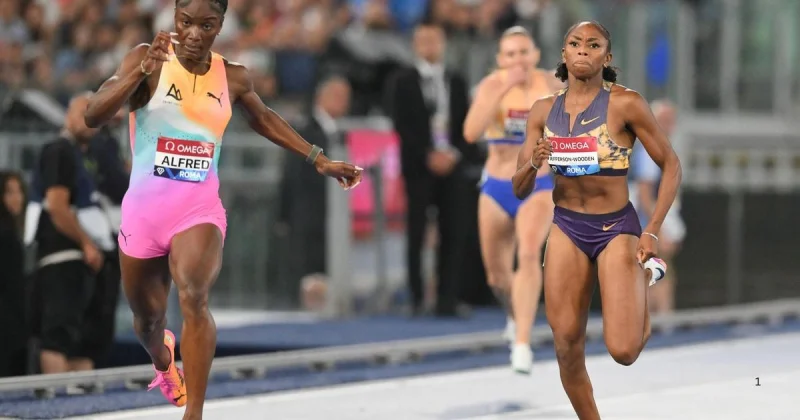
Melissa Jefferson-Wooden left Rome with a defeat on paper and a lift in confidence that matters more now than the result line. The 25-year-old said her second-place finish in the 200m at the Rome Diamond League on Thursday, where she ran 22.17 seconds behind Julien Alfred’s winning 21.93, showed she is ready to run something really fast when she steps down to the 100m in Stockholm on Sunday.
That is why her comments in Stockholm on Saturday are drawing attention now. Sunday will bring Jefferson-Wooden’s first 100m race of the season, and she arrives with a personal best of 10.61 seconds that makes her one of the biggest names in the field. She is not trying to fix a target time in advance. She said she does not have a set number in mind and wants the race decided by execution, adding that if she does that, whatever time comes out should leave her satisfied.
The Rome run gives that view some weight. Jefferson-Wooden did not win, but the time was quick enough to suggest the speed is there as she turns to the distance that has defined much of her career. Last year she beat Julien Alfred for both the 100m and 200m world titles, and this weekend offers another direct measure of where the two stand now, with Alfred’s recent 200m form in Rome underlining how sharp the challenge remains.
Stockholm will also frame Jefferson-Wooden against a stronger sprint group than a simple season opener might suggest. Dina Asher-Smith, who owns a 10.83 personal best, is also set to run her first 100m of the campaign, while Amy Hunt arrives after running 11.12 seconds this year and Zaynab Dosso has clocked 11.07 seconds in 2026. For Jefferson-Wooden, the race is less about chasing a number than about proving the 200m speed from Rome can transfer immediately to the straightaway.
That is the unresolved part heading into Sunday: how fast she can go when the gun goes off and the race belongs to the execution she keeps talking about. Rome suggested the answer may be quicker than the finishing place implied, and Stockholm will show whether that was a warning to the field or simply the first sign of a season building toward something bigger.
